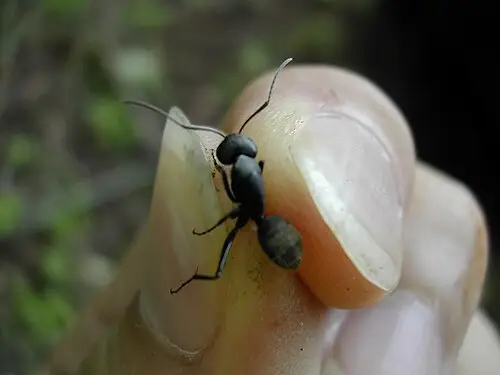
 📸 Photo
Photo: Imuzak · Public domain · Wikimedia Commons Source
Japanese carpenter ant
Camponotus japonicus (Japanese carpenter ant · クロオオアリ)
Not Evaluated (NE) on the IUCN Red List yet.
💡 Everyday Comparisons for Size, Mass & Speed
- 💡 The large black ants often seen gathering on flowers or around aphids in parks, flowerbeds, and village grasslands are frequently this species.
- 💡 The maximum worker length of 13 mm is about 0.7 times the diameter of a Korean 10-won coin (18 mm) (Comparison).
Reference standards: coach bus ~12 m, mid-size car ~4.9 m, compact car ~1 t, basketball hoop 3.05 m, credit card 8.56 cm.
📖 1. Overview
The Japanese carpenter ant is a large black ant commonly seen in fields and villages in Korea, building its nests underground.
🦴 2. Anatomy & Morphology
Workers are 7–13 mm long, black-bodied with fine brown hairs, and lack simple eyes (ocelli). Queens are about 17 mm long with a well-developed thorax, and males are about 11 mm long.
🔍 3. Ecology & Behavior
A colony ranges from 10 or fewer individuals to several hundred or more. They stay under stones in spring and under grass in summer before moving beneath tree roots or underground in autumn, and around October they have been observed going as deep as 1.3 m underground.
🇰🇷 4. Connection to Korea
It is a common species nationwide in Korea (northern, central, and southern regions, Jeju Island, and Ulleungdo). It is frequently seen gathering on flowers or around aphids.
📚 Sources & References
- • IUCN Red List: not evaluated (NE) — cross-checked with the Wikidata conservation-status entry
- • catalogueoflife.org — QDW6
- • 국가생물종목록(국립생물자원관) ktsn 120000029482 — https://species.nibr.go.kr/home/mainHome.do?cont_link=009&subMenu=009002&contCd=009002&ktsn=120000029482
- • wikidata.org — Q5028513
- • commons.wikimedia.org — File:Camponotus japonicus1.JPG
- • genebank.rda.go.kr — cyberView.bo
- • bok.or.kr — contents.do
- • Silhouette: PhyloPic — Kamil S. Jaron · CC0 1.0 (Congeneric silhouette — Camponotus)
Recorded dimensions are widely cited representative estimates from public literature and may vary by study or specimen.