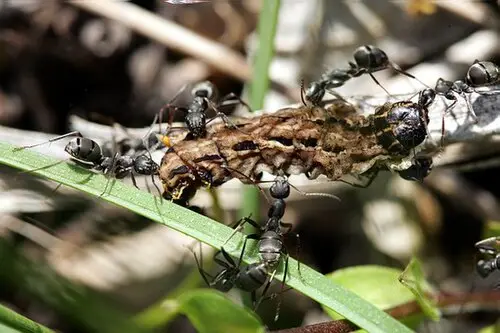
 📸 Photo
Photo: Kumon · CC BY 2.0 · Wikimedia Commons Source
Japanese wood ant
Formica japonica (Japanese wood ant · クロヤマアリ)
Not Evaluated (NE) on the IUCN Red List yet.
💡 Everyday Comparisons for Size, Mass & Speed
- 💡 The worker length of 4.5–6 mm is around one-fifth the diameter of a Korean 500-won coin (26.5 mm) (Comparison).
- 💡 It builds nests in open lots or under stones around homes and sometimes harms flowerbeds and field crops by tending aphids (National List of Species of Korea).
Reference standards: coach bus ~12 m, mid-size car ~4.9 m, compact car ~1 t, basketball hoop 3.05 m, credit card 8.56 cm.
📖 1. Overview
The Japanese wood ant is a medium-sized ant among Korean ants, inhabiting all of Korea and widely distributed across East Asia including Russia, Mongolia, Japan, and China.
🦴 2. Anatomy & Morphology
Its body is black to blackish-brown with scattered glossy grayish-brown hairs. Its head is oval and its petiole is thick and scale-shaped. Body length is about 13 mm in queens, 4.5–6 mm in workers, and about 11 mm in males.
🔍 3. Ecology & Behavior
It builds its nests mainly underground in dry grasslands or beneath stones and also overwinters underground. Adults appear from March to October and sometimes cause damage by tending aphids on garden and farm crops.
🇰🇷 4. Connection to Korea
It inhabits all of Korea, building nests in dry mountain grasslands or open lots around homes (National List of Species of Korea).
📚 Sources & References
- • IUCN Red List: not evaluated (NE) — cross-checked with the Wikidata conservation-status entry
- • catalogueoflife.org — 6JGGB
- • 국가생물종목록(국립생물자원관) ktsn 120000029512 — https://species.nibr.go.kr/home/mainHome.do?cont_link=009&subMenu=009002&contCd=009002&ktsn=120000029512
- • wikidata.org — Q3645437
- • commons.wikimedia.org — File:Hard work.jpg
- • species.nibr.go.kr — mainHome.do
- • Silhouette: PhyloPic — Mattia Menchetti · CC0 1.0 (Congeneric silhouette — Formica)
Recorded dimensions are widely cited representative estimates from public literature and may vary by study or specimen.