 📸 Photo
Photo: User:Bäras · CC BY-SA 3.0 · Wikimedia Commons Source
Thorny Devil
Moloch horridus (Thorny Devil · モロクトカゲ)
💡 Everyday Comparisons for Size, Mass & Speed
- 💡 Its maximum weight of 57 g is similar to that of a chicken egg (about 50–60 g) (Comparison).
- 💡 Its maximum length of 110 mm is slightly longer than the long side of a credit card (about 8.6 cm) (Comparison).
- 💡 Thanks to its distinctive appearance, it is popular in zoos (benefit to humans noted by ADW).
Reference standards: coach bus ~12 m, mid-size car ~4.9 m, compact car ~1 t, basketball hoop 3.05 m, credit card 8.56 cm.
Site-computed relative index from recorded values; not a formal scientific metric.
📖 1. Overview
The Thorny Devil is a small lizard living in sandy deserts of Australia, famous for the spines covering its entire body and its diet consisting exclusively of ants.
🦴 2. Anatomy & Morphology
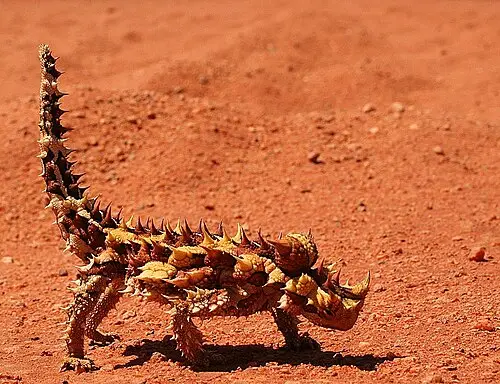
Its body is covered with thick shield-like scales and conical spines that have no bone inside, along with a large spiny knob behind the head. Its golden and brown blotched pattern camouflages it against arid ground.
🔍 3. Ecology & Behavior
A specialist that eats only ants, it hunts by sitting and waiting near ant trails. It is active in autumn (March–May) and from late winter to early summer (August–December), resting inside self-dug burrows during the hottest and coldest months.
🇰🇷 4. Connection to Korea
No direct record connecting this species to Korea has been found.
📚 Sources & References
- • IUCN Red List LC (2017) — https://www.iucnredlist.org/species/83492011/83492039
- • IUCN Red List category LC — latest assessment at iucnredlist.org
- • catalogueoflife.org — 43WS4
- • iucnredlist.org — 83492039
- • wikidata.org — Q320665
- • commons.wikimedia.org — File:Thornydevil02.jpg
- • animaldiversity.org — Moloch horridus
- • Silhouette: PhyloPic — Natalie Claunch · CC0 1.0 (Related taxon silhouette — Agama agama)
Recorded dimensions are widely cited representative estimates from public literature and may vary by study or specimen.