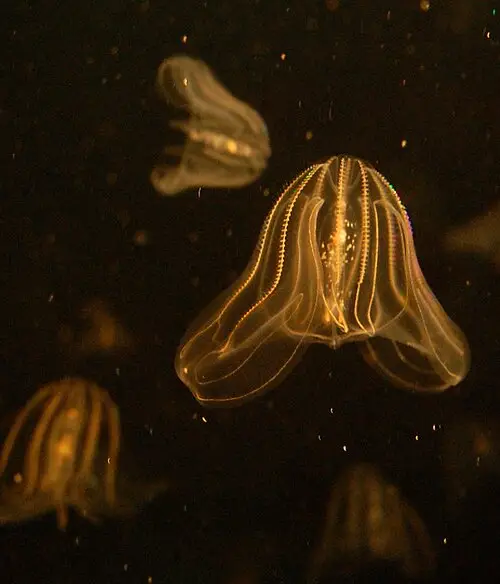
 📸 Photo
Photo: Steven G. Johnson · CC BY-SA 3.0 · Wikimedia Commons Source
Warty comb jelly
Mnemiopsis leidyi (Warty comb jelly · ムネミオプシス・レイディ)
Not Evaluated (NE) on the IUCN Red List yet.
💡 Everyday Comparisons for Size, Mass & Speed
- 💡 Because it feeds on fish eggs and young fish (SeaLifeBase), if it enters fishing grounds in large numbers it can affect fishery resources and commercial fishing.
- 💡 Its maximum total length of 18 cm is slightly shorter than the short side of an A4 sheet of paper (21 cm) (Comparison).
Reference standards: coach bus ~12 m, mid-size car ~4.9 m, compact car ~1 t, basketball hoop 3.05 m, credit card 8.56 cm.
📖 1. Overview
The warty comb jelly is a comb jelly native to the Atlantic coast of the Americas and widely inhabits marine and brackish waters.
🦴 2. Anatomy & Morphology
Its body has 8 meridional canals, and its form varies by region: Baltic Sea individuals are small with short oral lobes, whereas Black Sea individuals are longer. Its total length reaches up to 18 cm.
🔍 3. Ecology & Behavior
It is a carnivorous predator that eats zooplankton as well as fish eggs and larvae. It is a hermaphrodite and tolerates wide variations in salinity and temperature.
🇰🇷 4. Connection to Korea
No direct record connecting this species to Korea has been found.
📚 Sources & References
- • IUCN Red List: not evaluated (NE) — cross-checked with the Wikidata conservation-status entry
- • marinespecies.org — aphia.php
- • wikidata.org — Q133630
- • commons.wikimedia.org — File:Sea walnut, Boston Aquarium.jpg
- • sealifebase.se — Mnemiopsis-leidyi.html
- • Silhouette: PhyloPic — Arcadia Science · CC0 1.0
Recorded dimensions are widely cited representative estimates from public literature and may vary by study or specimen.