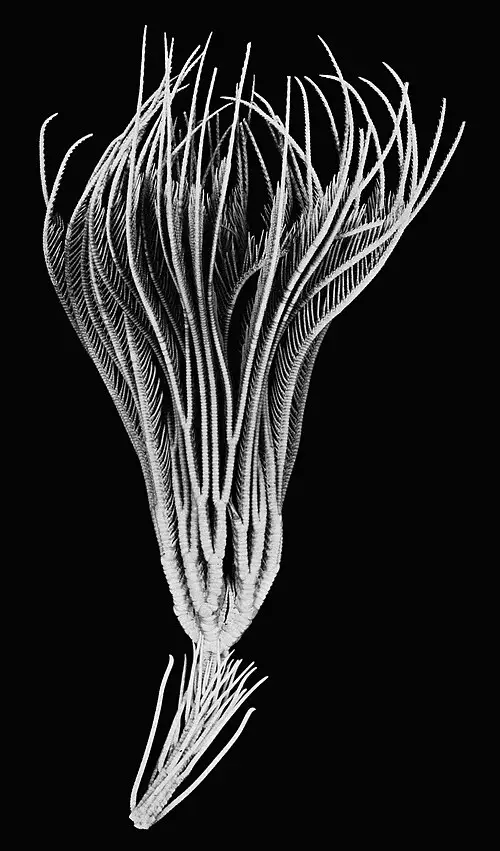
 📸 Photo
Photo: Hubert Lyman Clark · Public domain · Wikimedia Commons Source
Japanese sea lily
Metacrinus rotundus (Japanese sea lily · トリノアシ)
Not Evaluated (NE) on the IUCN Red List yet.
💡 Everyday Comparisons for Size, Mass & Speed
- 💡 Its recorded depth of 500 m is comparable to the height of Lotte World Tower (555 m) (Comparison).
- 💡 NOAA introduces this group (sea lilies) as one of the most fascinating organisms encountered during deep-sea exploration (NOAA Ocean Exploration).
Reference standards: coach bus ~12 m, mid-size car ~4.9 m, compact car ~1 t, basketball hoop 3.05 m, credit card 8.56 cm.
📖 1. Overview
The Japanese sea lily is a stalked sea lily (Isocrinidae) living on the sea floor at depths of 100–500 m in the Northwest Pacific.
🦴 2. Anatomy & Morphology
Sea lilies look like plants, but they are animals equipped with digestive and nervous systems. They spread their feathery arms toward water currents and can also release the cirri on their stalk to crawl using their arms.
🔍 3. Ecology & Behavior
Sexes are separate, and eggs and sperm are released into the water. Swimming larvae sink to the bottom and transform into stalked, sessile individuals.
🇰🇷 4. Connection to Korea
No direct record connecting this species to Korea has been found.
📚 Sources & References
- • IUCN Red List: not evaluated (NE) — cross-checked with the Wikidata conservation-status entry
- • marinespecies.org — aphia.php
- • wikidata.org — Q2459287
- • commons.wikimedia.org — File:BIOL. RESULTS ENDEAVOUR, Vol. IV, part I. Plate I (crop
- • sealifebase.se — Metacrinus-rotundus.html
- • oceanexplorer.noaa.gov — daily-image-media-20210127
- • Silhouette: PhyloPic — DataBase Center for Life Science (DBCLS) · CC BY 4.0
Recorded dimensions are widely cited representative estimates from public literature and may vary by study or specimen.