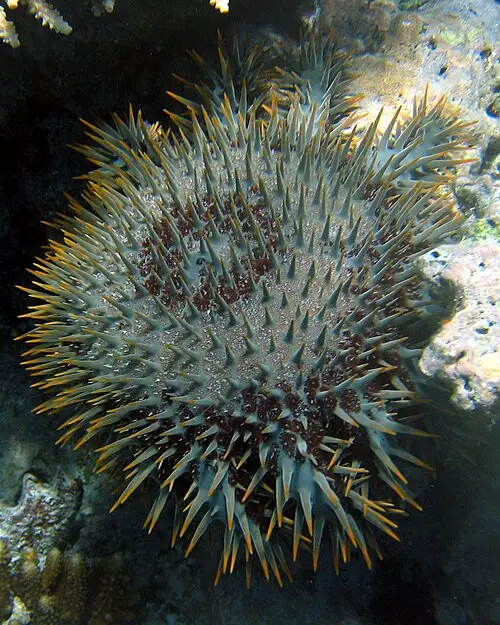
 📸 Photo
Photo: Matt Wright · CC BY 2.5 · Wikimedia Commons Source
Crown-of-thorns starfish
Acanthaster planci (Crown-of-thorns starfish · オニヒトデ)
Not Evaluated (NE) on the IUCN Red List yet.
💡 Everyday Comparisons for Size, Mass & Speed
- 💡 An arm-span diameter of 80 cm is about 2.7 times the long side of an A4 sheet of paper (29.7 cm) (Comparison).
- 💡 Contact with its venomous spines causes severe pain in humans as well. There are no known economic benefits to humans (ADW).
Reference standards: coach bus ~12 m, mid-size car ~4.9 m, compact car ~1 t, basketball hoop 3.05 m, credit card 8.56 cm.
📖 1. Overview
The crown-of-thorns starfish is a large starfish living on Indo-Pacific coral reefs that feeds on coral. It has 8–21 arms and venomous spines.
🦴 2. Anatomy & Morphology
From the central disc radiate 8–21 arms, with light-sensitive eyespots at the arm tips. Its diameter is usually 25–35 cm, and unlike other starfish it bears large venomous spines. Body color ranges from red and orange to purple, thought to vary with diet.
🔍 3. Ecology & Behavior
An opportunistic predator that eats stony corals and other corals, it also feeds on dead animals. It everts its stomach out through its mouth to digest coral tissue, being active at night and hiding among corals during the day.
🇰🇷 4. Connection to Korea
No direct record connecting this species to Korea has been found.
📚 Sources & References
- • IUCN Red List: not evaluated (NE) — cross-checked with the Wikidata conservation-status entry
- • marinespecies.org — aphia.php
- • wikidata.org — Q26634
- • commons.wikimedia.org — File:CrownofThornsStarfish Fiji 2005-10-12.jpg
- • sealifebase.se — Acanthaster-planci.html
- • animaldiversity.org — Acanthaster planci
- • Silhouette: PhyloPic — Zechariah Meunier · CC0 1.0
Recorded dimensions are widely cited representative estimates from public literature and may vary by study or specimen.