 📸 Photo
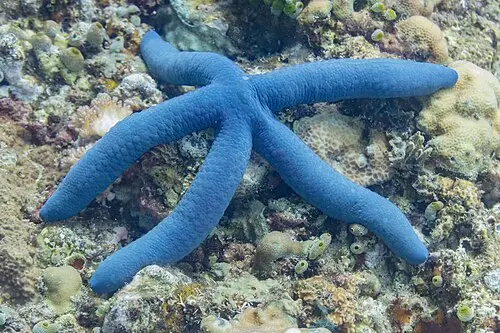
Photo: Diego Delso · CC BY-SA 4.0 · Wikimedia Commons Source
Blue sea star
Linckia laevigata (Blue sea star · アオヒトデ)
Not Evaluated (NE) on the IUCN Red List yet.
💡 Everyday Comparisons for Size, Mass & Speed
- 💡 Its arm span diameter of 40 cm is longer than the long side of an A4 sheet of paper (29.7 cm) (Comparison).
- 💡 Its body weight of 16 g is about the weight of two Korean 500-won coins (7.7 g each) (Comparison).
- 💡 It is dried for decoration or kept in aquariums and is popular with tourists. Researchers are also testing whether anticancer and antibacterial substances can be obtained from it (ADW positive impacts for humans).
Reference standards: coach bus ~12 m, mid-size car ~4.9 m, compact car ~1 t, basketball hoop 3.05 m, credit card 8.56 cm.
Site-computed relative index from recorded values; not a formal scientific metric.
📖 1. Overview
The blue sea star is a blue starfish living on tropical coral reefs of the Indo-West Pacific. In Korea, it lives in rocky reef areas south of Jeju Island.
🦴 2. Anatomy & Morphology
It has 5 long cylindrical arms, a bright blue or sky-blue body, and yellow tube feet. Its blue color comes from a pigment called linckiacyanin, and it looks vivid blue under sunlight.
🔍 3. Ecology & Behavior
It is active at night and hides in rock crevices during the day. It eats dead animals, small invertebrates, and bottom detritus, everting its stomach outside its body to digest food. In summer (May–August), it reproduces by releasing eggs and sperm into the water.
🇰🇷 4. Connection to Korea
It is listed on the National List of Species of Korea and is distributed in rocky reef areas of southern Jeju Island under the influence of the Kuroshio Current.
📚 Sources & References
- • IUCN Red List: not evaluated (NE) — cross-checked with the Wikidata conservation-status entry
- • marinespecies.org — aphia.php
- • 국가생물종목록(국립생물자원관) ktsn 120000050560 — https://species.nibr.go.kr/home/mainHome.do?cont_link=009&subMenu=009002&contCd=009002&ktsn=120000050560
- • wikidata.org — Q882716
- • commons.wikimedia.org — File:Estrella de mar azul (Linckia laevigata), Anilao, Filip
- • sealifebase.se — Linckia-laevigata.html
- • animaldiversity.org — Linckia laevigata
- • species.nibr.go.kr — mainHome.do
Recorded dimensions are widely cited representative estimates from public literature and may vary by study or specimen.