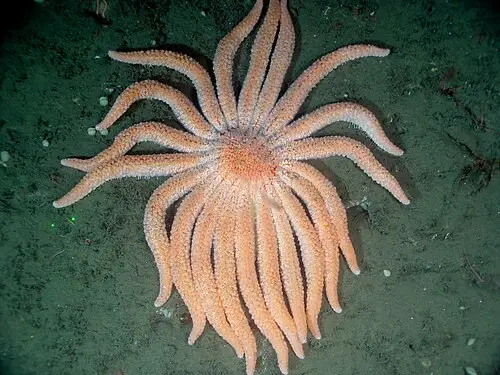
 📸 Photo
Photo: Ed Bowlby, NOAA/Olympic Coast NMS; NOAA/OAR/Office of Ocean Exploration. · Public domain · Wikimedia Commons Source
Sunflower sea star
Pycnopodia helianthoides (Sunflower sea star · ニチリンヒトデ)
💡 Everyday Comparisons for Size, Mass & Speed
- 💡 In the United States, NOAA highlights research on rearing and breeding this sea star to restore threatened kelp forests in California and has proposed listing it as threatened under the Endangered Species Act (NOAA).
- 💡 Its arm span diameter of 0.91 m is about the height of a front door handle (about 0.9–1 m) (Comparison).
Reference standards: coach bus ~12 m, mid-size car ~4.9 m, compact car ~1 t, basketball hoop 3.05 m, credit card 8.56 cm.
📖 1. Overview
The sunflower sea star is a large sea star living in the Northeast Pacific and is the second largest sea star in the world. It is listed as Critically Endangered (CR, 2021) on the IUCN Red List.
🦴 2. Anatomy & Morphology
Its arm span diameter reaches up to about 3 feet (about 0.9 m).
🔍 3. Ecology & Behavior
Because it is a large sea star that preys on sea urchins, when its numbers decline, sea urchins multiply and graze down kelp forests. It fertilizes eggs by broadcasting eggs and sperm into the water, so mates must be close together, and its population dropped sharply when sea star wasting syndrome spread from 2013 to 2017.
🇰🇷 4. Connection to Korea
No direct record connecting this species to Korea has been found.
📚 Sources & References
- • IUCN Red List CR (2021) — https://www.iucnredlist.org/species/178290276/197818455
- • IUCN Red List category CR — latest assessment at iucnredlist.org
- • marinespecies.org — aphia.php
- • iucnredlist.org — 197818455
- • wikidata.org — Q1857023
- • commons.wikimedia.org — File:Olympic Coast National Marine Sanctuary 2010 Pycnopodia
- • fisheries.noaa.gov — noaa-fisheries-weighs-protection-sunflower-sea-star-native-w
- • fisheries.noaa.gov — sunflower-sea-star
- • Silhouette: PhyloPic — author not recorded · CC0 1.0
Recorded dimensions are widely cited representative estimates from public literature and may vary by study or specimen.