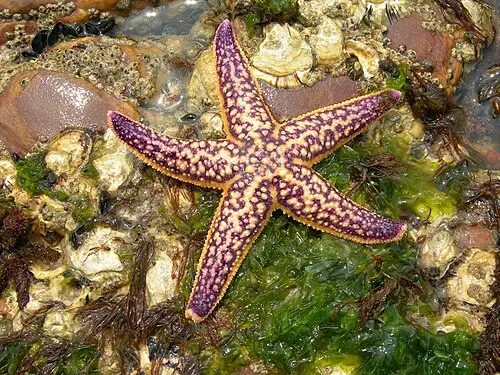
 📸 Photo
Photo: No machine-readable author provided. Lycoo assumed (based on copyright claims). · Public domain · Wikimedia Commons Source
Northern Pacific seastar
Asterias amurensis (Northern Pacific seastar · キヒトデ)
Not Evaluated (NE) on the IUCN Red List yet.
💡 Everyday Comparisons for Size, Mass & Speed
- 💡 An arm-span diameter of 50 cm is about 1.7 times the long side of an A4 sheet of paper (29.7 cm) (Comparison).
- 💡 In its native Japan, it has caused major damage to the shellfish aquaculture industry (ADW).
Reference standards: coach bus ~12 m, mid-size car ~4.9 m, compact car ~1 t, basketball hoop 3.05 m, credit card 8.56 cm.
📖 1. Overview
The northern Pacific seastar is a large starfish living along the North Pacific coast and can be seen along all coasts of Korea. It is known to cause heavy damage to aquaculture farms.
🦴 2. Anatomy & Morphology
It usually has 5 arms with slightly upturned tips. The arms widen and thicken from the tips toward the central disc, and the dorsal spines are short but strong and rough. Body color is commonly beige with purple markings.
🔍 3. Ecology & Behavior
Both a predator and a scavenger, it favors bivalves such as mussels most, while also eating carrion, barnacles, and seaweeds. Its numbers surge around food-rich aquaculture farms, and it usually mates and spawns in April–May.
🇰🇷 4. Connection to Korea
It is listed in the National List of Species of Korea and is found along all Korean coasts. It is known to cause severe damage not only to farmed shellfish at aquaculture sites but also to marine ecosystems.
📚 Sources & References
- • IUCN Red List: not evaluated (NE) — cross-checked with the Wikidata conservation-status entry
- • marinespecies.org — aphia.php
- • 국가생물종목록(국립생물자원관) ktsn 120000050600 — https://species.nibr.go.kr/home/mainHome.do?cont_link=009&subMenu=009002&contCd=009002&ktsn=120000050600
- • wikidata.org — Q1140786
- • commons.wikimedia.org — File:海星(正面).JPG
- • animaldiversity.org — Asterias amurensis
- • species.nibr.go.kr — mainHome.do
- • sealifebase.se — Asterias-amurensis.html
- • Silhouette: PhyloPic — Zechariah Meunier · CC0 1.0 (Congeneric silhouette — Acanthaster planci)
Recorded dimensions are widely cited representative estimates from public literature and may vary by study or specimen.