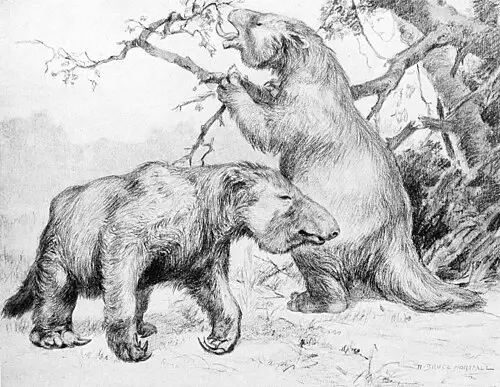
 🎨 Restoration
Restoration: R. Bruce Horsfall · Public domain · Wikimedia Commons Source
Life restorations are artistic reconstructions based on fossil evidence; true coloration and soft-tissue details remain uncertain.
Megatherium
Megatherium americanum (Megatherium · Megatherium)
Known only from fossils. The IUCN Red List assesses only species extant since 1500 CE, so fossil taxa are not assigned a category.
💡 Everyday Comparisons for Size, Mass & Speed
- 💡 Its standing height of 3.5 m is about 1.5 times the ceiling height of an apartment room (about 2.3 m) (Comparison). Its maximum weight of 4 tonnes is similar to that of a male elephant (Natural History Museum, London).
- 💡 A cast of a Megatherium skeleton is on display at the Natural History Museum, London, and a 3D scan of a skull fossil collected by Charles Darwin during the voyage of the Beagle has been made publicly available.
Reference standards: coach bus ~12 m, mid-size car ~4.9 m, compact car ~1 t, basketball hoop 3.05 m, credit card 8.56 cm.
Site-computed relative index from recorded values; not a formal scientific metric.
📖 1. Overview
Megatherium americanum (genus Megatherium) was a giant ground sloth that lived in South America; its name means 'great beast from America.' It was up to 10 times the size of living tree sloths.
🦴 2. Anatomy & Morphology
It could stand on its hind legs and was the largest bipedal mammal. Although it had large claws, chemical analysis of its teeth confirmed that it was a herbivore that ate plants.
🔍 3. Fossil Record & Paleoecology
First discovered in Argentina in 1787, its fossils come from strata dating between about 400,000 and about 8,000 years ago. It lived alongside humans, and cut marks remain on some fossil bones.
🇰🇷 4. Connection to Korea
No direct record connecting this species to Korea has been found.
📚 Sources & References
- • Fossil taxon — the IUCN Red List assesses only species living or extinct since 1500
- • paleobiodb.org — basicTaxonInfo
- • wikidata.org — Q1471947
- • commons.wikimedia.org — File:Megatherium americanum Skeleton NHM.JPG
- • nhm.ac.uk — what-was-megatherium.html
Recorded dimensions are widely cited representative estimates from public literature and may vary by study or specimen.