 📸 Photo
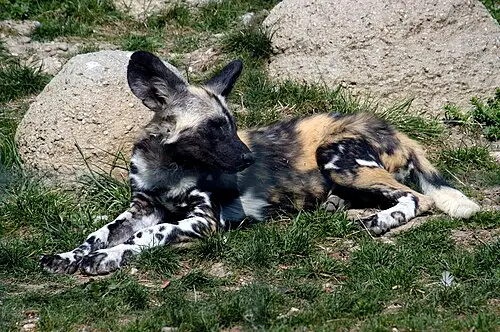
Photo: Peter Ruckstuhl at German Wikipedia · CC BY-SA 3.0 · Wikimedia Commons Source
African Wild Dog
Lycaon pictus (African Wild Dog · リカオン)
💡 Everyday Comparisons for Size, Mass & Speed
- 💡 Its maximum weight of 36 kg is nearly two 20 kg bags of rice, and its body length of 1.1 m is around the height of a lower-grade elementary school child (Comparison).
- 💡 Today's average pack size of 7–15 individuals is about half the size of a school class (about 25 students) (Comparison); packs of 100 were once recorded (ADW).
Reference standards: coach bus ~12 m, mid-size car ~4.9 m, compact car ~1 t, basketball hoop 3.05 m, credit card 8.56 cm.
Site-computed relative index from recorded values; not a formal scientific metric.
📖 1. Overview
The African Wild Dog is a pack hunter living on the plains south of the Sahara. Its scientific name Lycaon pictus means 'painted wolf.'
🦴 2. Anatomy & Morphology
Its coat looks painted with a mix of brown, red, black, yellow, and white, and the pattern differs for each individual like zebra stripes. It is characterized by large rounded ears, a lean body, and long muscular legs with 4 toes on both forefeet and hindfeet, and a white tail tip.
🔍 3. Ecology & Behavior
Packs reach up to 40 individuals and today average 7–15. Only the dominant pair breeds, and the pack hunts prey about twice its own weight—such as Impalas and bush duikers (Sylvicapra grimmia)—as well as weak or sick wildebeests and zebras. Its lifespan is about 10 years.
🇰🇷 4. Connection to Korea
No direct record connecting this species to Korea has been found.
📚 Sources & References
- • IUCN Red List EN (2025) — https://www.iucnredlist.org/species/12436/221299510
- • IUCN Red List category EN — latest assessment at iucnredlist.org
- • mammaldiversity.org — 1005960
- • iucnredlist.org — 221299510
- • wikidata.org — Q173651
- • commons.wikimedia.org — File:Lycaon pictus.jpg
- • animaldiversity.org — Lycaon pictus
- • Silhouette: PhyloPic — Holly English · CC0 1.0
Recorded dimensions are widely cited representative estimates from public literature and may vary by study or specimen.