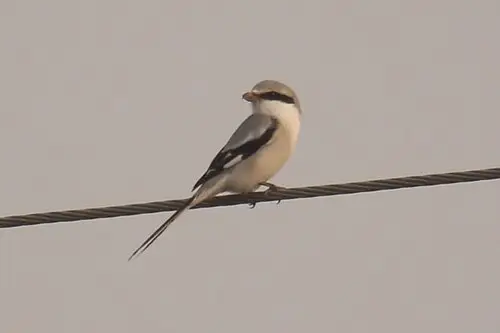
 📸 Photo
Photo: Alastair Rae from London, United Kingdom · CC BY-SA 2.0 · Wikimedia Commons Source
Chinese Grey Shrike
Lanius sphenocercus (Chinese Grey Shrike · オオカラモズ)
💡 Everyday Comparisons for Size, Mass & Speed
- 💡 Its body length of 31 cm is almost the same as a 30 cm ruler (Comparison).
- 💡 Because it hunts even small mice and frogs, it is known as a carnivorous hunter despite its modest size (National List of Species of Korea).
Reference standards: coach bus ~12 m, mid-size car ~4.9 m, compact car ~1 t, basketball hoop 3.05 m, credit card 8.56 cm.
📖 1. Overview
The Chinese Grey Shrike is a large shrike measuring 31 cm in body length that visits Korea in small numbers nationwide as a rare winter visitor.
🦴 2. Anatomy & Morphology
Its crown and upperparts are gray, and its supercilium is white. A broad black eye stripe runs below the bill and eyes, its underparts—including the throat and breast—and rump are white, and its legs are black.
🔍 3. Ecology & Behavior
Living mainly alone or in pairs, it favors small rodents, frogs, reptiles, beetles, caterpillar larvae, and spiders. It builds a bowl-shaped nest of dry twigs and grass on tree branches and lays 6–9 eggs from early May to early June.
🇰🇷 4. Connection to Korea
According to the National List of Species of Korea, it is a rare winter visitor arriving and wintering in small numbers nationwide.
📚 Sources & References
- • IUCN Red List LC (2024) — https://www.iucnredlist.org/species/103718766/263771068
- • IUCN Red List category LC — latest assessment at iucnredlist.org
- • doi.org — avilist.v2026
- • iucnredlist.org — 263771068
- • 국가생물종목록(국립생물자원관) ktsn 120000001939 — https://species.nibr.go.kr/home/mainHome.do?cont_link=009&subMenu=009002&contCd=009002&ktsn=120000001939
- • wikidata.org — Q1076000
- • commons.wikimedia.org — File:Chinese Grey Shrike (15690680610).jpg
- • species.nibr.go.kr — mainHome.do
- • Silhouette: PhyloPic — Zeynel Cebeci · CC BY 4.0 (Congeneric silhouette — Lanius collurio)
Recorded dimensions are widely cited representative estimates from public literature and may vary by study or specimen.