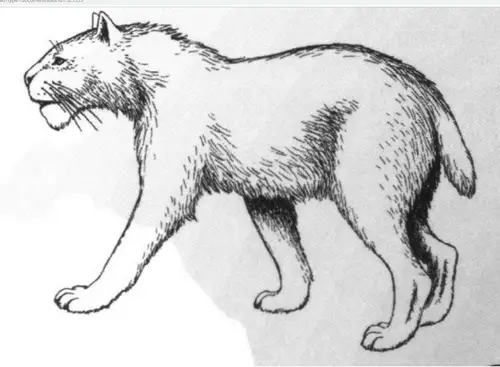
 🎨 Restoration
Restoration: Wilrie van Logchem & Dick Mol · CC BY 4.0 · Wikimedia Commons Source
Life restorations are artistic reconstructions based on fossil evidence; true coloration and soft-tissue details remain uncertain.
Homotherium
Homotherium latidens (Homotherium · Homotherium)
Known only from fossils. The IUCN Red List assesses only species extant since 1500 CE, so fossil taxa are not assigned a category.
💡 Everyday Comparisons for Size, Mass & Speed
- 💡 The description that it was the size of a full-grown lion can be pictured by thinking of a lion seen at a zoo (Comparison).
- 💡 The Schöningen excavation is an ongoing archaeological dig conducted by the University of Tübingen and German research institutions, and the third individual was reported in excavation news in 2017.
Reference standards: coach bus ~12 m, mid-size car ~4.9 m, compact car ~1 t, basketball hoop 3.05 m, credit card 8.56 cm.
📖 1. Overview
Homotherium latidens (genus Homotherium) was a saber-toothed cat (family Felidae) that lived during the Pleistocene. Several individuals dating to about 300,000 years ago were found at the Schöningen site in Germany.
🦴 2. Anatomy & Morphology
The University of Tübingen notes that it had long claws and sharp, sickle-curved canine teeth, and was about the size of a full-grown lion.
🔍 3. Fossil Record & Paleoecology
At Schöningen, the skull of a third individual was found nearly intact, allowing researchers even to infer the shape of its brain. The excavation team states that it was not rare about 300,000 years ago and was a dangerous predator competing with humans.
🇰🇷 4. Connection to Korea
No direct record connecting this species to Korea has been found.
📚 Sources & References
- • Fossil taxon — the IUCN Red List assesses only species living or extinct since 1500
- • paleobiodb.org — basicTaxonInfo
- • wikidata.org — Q5901456
- • commons.wikimedia.org — File:Homotherium latidens cub mummy fig2 (cropped).webp
- • uni-tuebingen.de — successful-dig-reveals-an-almost-complete-skull-of-a-saber-t
- • Silhouette: PhyloPic — Ivan Iofrida · CC BY 4.0 (Congeneric silhouette — Homotherium)
Recorded dimensions are widely cited representative estimates from public literature and may vary by study or specimen.