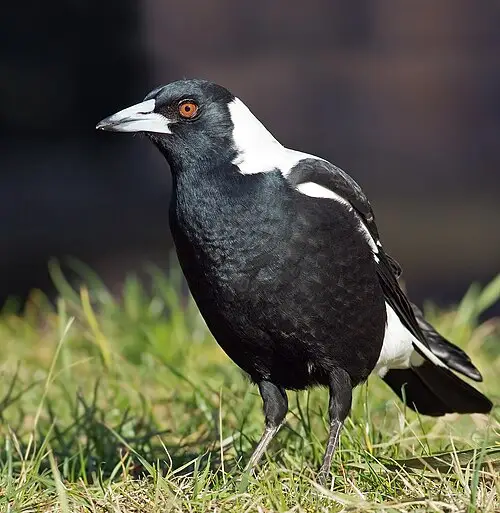
 📸 Photo
Photo: JJ Harrison ( https://www.jjharrison.com.au/ ) · CC BY-SA 3.0 · Wikimedia Commons Source
Australian Magpie
Gymnorhina tibicen (Australian Magpie · カササギフエガラス)
💡 Everyday Comparisons for Size, Mass & Speed
- 💡 During the breeding season, some individuals swoop at people approaching their nests as a warning flight (Australian Museum).
- 💡 It mimics the calls of over 35 bird species as well as dogs, horses, and sometimes even human speech (Australian Museum).
- 💡 It is commonly seen in parks and sports fields as well (Australian Museum).
Reference standards: coach bus ~12 m, mid-size car ~4.9 m, compact car ~1 t, basketball hoop 3.05 m, credit card 8.56 cm.
📖 1. Overview
The Australian Magpie is a common black-and-white bird of Australia and one of the country's most beloved songbirds for its clear, flute-like caroling.
🦴 2. Anatomy & Morphology
It has black-and-white plumage whose pattern varies by region. Males have a white hindneck, upper tail, and shoulders while females are gray there, and in southeastern, central, and far southwestern Australia as well as Tasmania, the entire back and rump are white. Adults have chestnut-red eyes.
🔍 3. Ecology & Behavior
It walks on the ground searching for insects and larvae, and also takes food offered by people. Groups of up to 24 birds defend a territory year-round and build a bowl-shaped stick nest during the August–November breeding season, laying 3–5 eggs.
🇰🇷 4. Connection to Korea
No direct record connecting this species to Korea has been found.
📚 Sources & References
- • IUCN Red List LC (2018) — https://www.iucnredlist.org/species/22706288/131945700
- • IUCN Red List category LC — latest assessment at iucnredlist.org
- • doi.org — avilist.v2026
- • iucnredlist.org — 131945700
- • wikidata.org — Q1140949
- • commons.wikimedia.org — File:Cracticus tibicen hypoleuca male domain.jpg
- • australian.museum — australian-magpie
- • Silhouette: PhyloPic — Michael Scroggie · CC0 1.0 (Related taxon silhouette — Strepera graculina)
Recorded dimensions are widely cited representative estimates from public literature and may vary by study or specimen.