 📸 Photo
Photo: Sumeetmoghe · CC BY-SA 4.0 · Wikimedia Commons Source
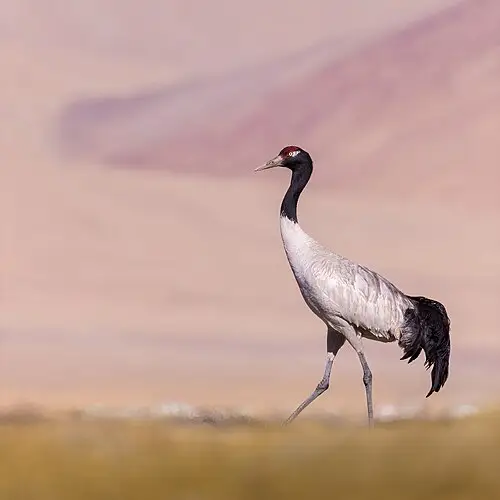
Black-necked Crane
Grus nigricollis (Black-necked Crane · オグロヅル)
💡 Everyday Comparisons for Size, Mass & Speed
- 💡 Its weight of 5.35 kg is about half of a 10 kg bag of rice (Comparison).
- 💡 Its height of 115 cm reaches between an adult's waist and chest (Comparison).
- 💡 The International Crane Foundation notes that it also feeds on leftover grain in agricultural fields after harvest.
Reference standards: coach bus ~12 m, mid-size car ~4.9 m, compact car ~1 t, basketball hoop 3.05 m, credit card 8.56 cm.
Site-computed relative index from recorded values; not a formal scientific metric.
📖 1. Overview
The Black-necked Crane is a large crane that breeds in the Himalayan mountains, central China, and northern India. In winter, it descends from high elevations to spend the season in southern China and Bhutan.
🦴 2. Anatomy & Morphology
It stands about 115 cm tall and weighs about 5.35 kg. As its English name (Black-necked Crane) suggests, its black neck is a distinctive feature.
🔍 3. Ecology & Behavior
It eats a wide range of foods including plant roots and tubers, insects, snails, shrimp, fish, frogs, lizards, voles, and leftover grain in harvested fields. Alternating unison calls between males and females are used to strengthen pair bonds and defend territories.
🇰🇷 4. Connection to Korea
No direct record connecting this species to Korea has been found.
📚 Sources & References
- • IUCN Red List NT (2020) — https://www.iucnredlist.org/species/22692162/180030167
- • IUCN Red List category NT — latest assessment at iucnredlist.org
- • doi.org — avilist.v2026
- • iucnredlist.org — 180030167
- • wikidata.org — Q261445
- • commons.wikimedia.org — File:Black necked crane at Hanle.jpg
- • savingcranes.org — black-necked-crane
- • Silhouette: PhyloPic — Mathieu Pélissié · CC BY 4.0 (Congeneric silhouette — Grus grus)
Recorded dimensions are widely cited representative estimates from public literature and may vary by study or specimen.