 📸 Photo
Photo: Sasata · CC BY-SA 3.0 · Wikimedia Commons Source
Whooping Crane
Grus americana (Whooping Crane · アメリカシロヅル)
💡 Everyday Comparisons for Size, Mass & Speed
- 💡 Its height of 1.5 m reaches about chest level on an adult, and its wingspan of 2.3 m is about half the length of a compact car (about 4.5 m) (Comparison).
- 💡 Thousands of visitors come each year to Aransas National Wildlife Refuge, where it winters, to see this bird (Animal Diversity Web).
- 💡 Regarded as a symbol of conservation and international cooperation, it serves as a model showcasing successful wildlife conservation (Animal Diversity Web).
Reference standards: coach bus ~12 m, mid-size car ~4.9 m, compact car ~1 t, basketball hoop 3.05 m, credit card 8.56 cm.
Site-computed relative index from recorded values; not a formal scientific metric.
📖 1. Overview
The Whooping Crane is the tallest bird in North America, with a white body and long legs. Only one self-sustaining wild flock remains, wintering at the Aransas National Wildlife Refuge in Texas and breeding in Wood Buffalo National Park in Canada.
🦴 2. Anatomy & Morphology
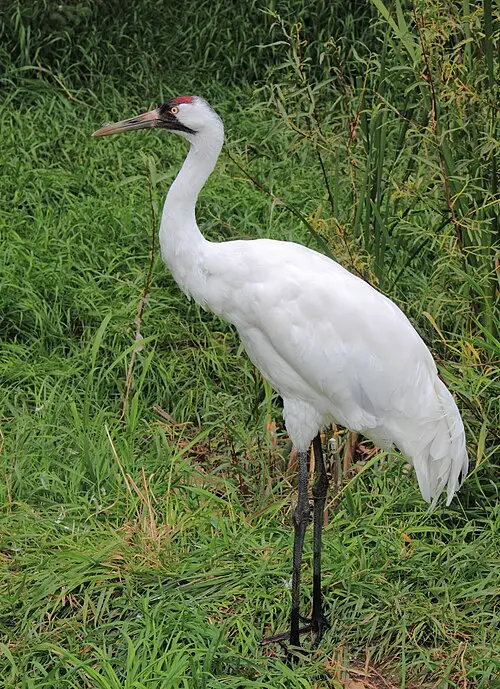
Its body is mostly white while its primary wing feathers and long legs are black. Its crown and face have bare skin without feathers, its eyes are yellow, and its bill is pinkish at the base.
🔍 3. Ecology & Behavior
It is an omnivore that mainly eats blue crabs and wolfberries in winter, and minnows and insects on its breeding grounds. Males and females form pairs and strengthen their bond by dancing and calling in unison.
🇰🇷 4. Connection to Korea
No direct record connecting this species to Korea has been found.
📚 Sources & References
- • IUCN Red List EN (2020) — https://www.iucnredlist.org/species/22692156/181242855
- • IUCN Red List category EN — latest assessment at iucnredlist.org
- • doi.org — avilist.v2026
- • iucnredlist.org — 181242855
- • wikidata.org — Q457477
- • commons.wikimedia.org — File:Grus americana Sasata.jpg
- • animaldiversity.org — Grus americana
- • nationalzoo.si.edu — whooping-crane
- • Silhouette: PhyloPic — Kai Caspar · CC0 1.0 (Congeneric silhouette — Grus virgo)
Recorded dimensions are widely cited representative estimates from public literature and may vary by study or specimen.