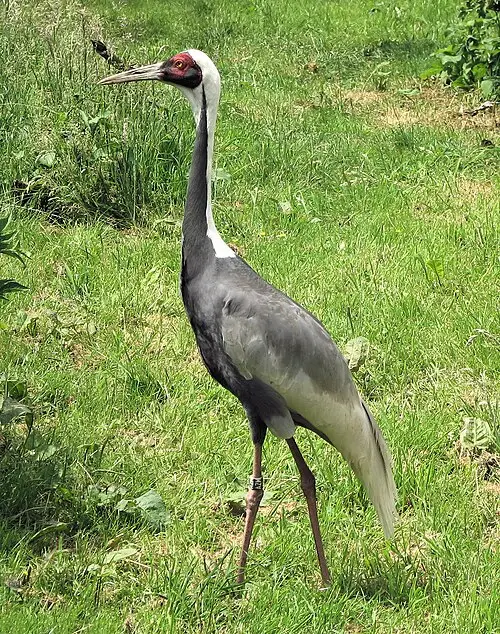
 📸 Photo
Photo: Adrian Pingstone ( Arpingstone ) · Public domain · Wikimedia Commons Source
White-naped Crane
Antigone vipio (White-naped Crane · マナヅル)
🇰🇷 Class II endangered wildlife (Korea) · Natural Monument (Korea) «White-naped Crane»
💡 Everyday Comparisons for Size, Mass & Speed
- 💡 Its standing height of about 1.3 m is about 2/3 the height of a standard door (about 2 m) (Comparison).
- 💡 Its weight of about 5.6 kg is just over half of a 10 kg bag of rice (Comparison).
- 💡 The International Crane Foundation highlights winter fields in Korea such as Cheorwon as wintering grounds in need of protection.
Reference standards: coach bus ~12 m, mid-size car ~4.9 m, compact car ~1 t, basketball hoop 3.05 m, credit card 8.56 cm.
Site-computed relative index from recorded values; not a formal scientific metric.
📖 1. Overview
The White-naped Crane is a large crane that breeds in northeastern Mongolia, northeastern China, and southeastern Russia and winters on the Korean Peninsula, in Japan, and along the middle Yangtze River in China. It is listed as Vulnerable (VU) by the IUCN.
🦴 2. Anatomy & Morphology
It is a large bird standing about 1.3 m tall and weighing in the mid-5 kg range. As its English name (White-naped) suggests, the back of its neck is white.
🔍 3. Ecology & Behavior
It eats insects, small vertebrates, seeds, roots and tubers, wetland plants, and fallen grain. About 2,000 birds of the eastern population pass through the Korean Peninsula, with several hundred wintering in the Demilitarized Zone (DMZ) and the rest continuing to Kyushu, Japan.
🇰🇷 4. Connection to Korea
In Korea it is Class II endangered wildlife (Korea) and was designated as a Natural Monument (Korea) on May 31, 1968 (1968-05-31). The International Crane Foundation notes that about 2,000 birds of the eastern population pass through the Korean Peninsula and several hundred winter in the DMZ.
📚 Sources & References
- • IUCN Red List VU (2018) — https://www.iucnredlist.org/species/22692073/131927305
- • 멸종위기 야생생물 Ⅱ급 · 천연기념물 «재두루미» — 국가생물종목록(국립생물자원관) ktsn 120000001650 — https://species.nibr.go.kr/home/mainHome.do?cont_link=009&subMenu=009002&contCd=009002&ktsn=120000001650
- • IUCN Red List category VU — latest assessment at iucnredlist.org
- • Korean protection status: Class II endangered wildlife (Korea) · Natural Monument (Korea) «White-naped Crane»
- • doi.org — avilist.v2026
- • iucnredlist.org — 131927305
- • 국가생물종목록(국립생물자원관) ktsn 120000001650 — https://species.nibr.go.kr/home/mainHome.do?cont_link=009&subMenu=009002&contCd=009002&ktsn=120000001650
- • heritage.go.kr — culSelectDetail.do
- • wikidata.org — Q27452479
- • commons.wikimedia.org — File:White-naped crane arp.jpg
- • savingcranes.org — white-naped-crane
- • Silhouette: PhyloPic — Andy Wilson · CC0 1.0 (Related taxon silhouette — Antigone canadensis)
Recorded dimensions are widely cited representative estimates from public literature and may vary by study or specimen.