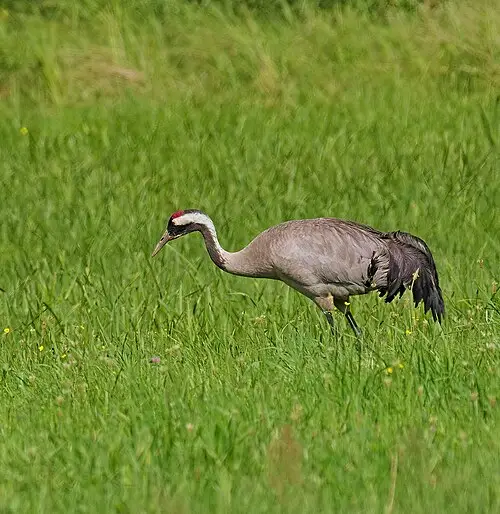
 📸 Photo
Photo: Andreas Eichler · CC BY-SA 4.0 · Wikimedia Commons Source
Common Crane
Grus grus (Common Crane · クロヅル)
🇰🇷 Class II endangered wildlife (Korea) · Natural Monument (Korea) «Common Crane»
💡 Everyday Comparisons for Size, Mass & Speed
- 💡 Its wingspan of about 2.1 m is wider than the width of a passenger car (about 1.8 m) (Comparison).
- 💡 Its weight of about 5.5 kg is slightly more than half of a 10 kg bag of rice (Comparison).
- 💡 The International Crane Foundation notes that this bird eats even sown grain and fallen kernels.
Reference standards: coach bus ~12 m, mid-size car ~4.9 m, compact car ~1 t, basketball hoop 3.05 m, credit card 8.56 cm.
Site-computed relative index from recorded values; not a formal scientific metric.
📖 1. Overview
The Common Crane breeds widely from northern and western Europe to eastern Siberia, northern Mongolia, and northern China, and winters in southwestern Europe, northern Africa, India, and southeastern China. Its population exceeds 790,000 birds, and it is listed as Least Concern (LC) by the IUCN.
🦴 2. Anatomy & Morphology
It stands about 1.15 m tall, weighs about 5.5 kg, and has a wingspan reaching about 2.1 m.
🔍 3. Ecology & Behavior
It is an omnivore that eats insects, amphibians, reptiles, and small mammals, as well as acorns, sown grain, and fallen kernels.
🇰🇷 4. Connection to Korea
In Korea, it is listed in the National List of Species of Korea under the name "Geomeun-mok-durumi" (Korean name), is a Class II endangered wildlife species (Korea), and was designated as a Natural Monument (Korea) on March 17, 2005.
📚 Sources & References
- • IUCN Red List LC (2025) — https://www.iucnredlist.org/species/22692146/265333107
- • 멸종위기 야생생물 Ⅱ급 · 천연기념물 «검은목두루미» — 국가생물종목록(국립생물자원관) ktsn 120000001651 — https://species.nibr.go.kr/home/mainHome.do?cont_link=009&subMenu=009002&contCd=009002&ktsn=120000001651
- • IUCN Red List category LC — latest assessment at iucnredlist.org
- • Korean protection status: Class II endangered wildlife (Korea) · Natural Monument (Korea) «Common Crane»
- • doi.org — avilist.v2026
- • iucnredlist.org — 265333107
- • 국가생물종목록(국립생물자원관) ktsn 120000001651 — https://species.nibr.go.kr/home/mainHome.do?cont_link=009&subMenu=009002&contCd=009002&ktsn=120000001651
- • heritage.go.kr — culSelectDetail.do
- • wikidata.org — Q4764
- • commons.wikimedia.org — File:2017.07.04.-01-Wendisch Rietz--Kranich.jpg
- • savingcranes.org — eurasian-crane
- • Silhouette: PhyloPic — Andy Wilson · CC0 1.0
Recorded dimensions are widely cited representative estimates from public literature and may vary by study or specimen.