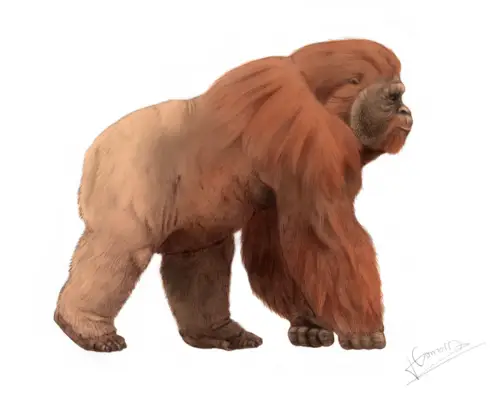
 🎨 Restoration
Restoration: Concavenator · CC BY-SA 4.0 · Wikimedia Commons Source
Life restorations are artistic reconstructions based on fossil evidence; true coloration and soft-tissue details remain uncertain.
Gigantopithecus
Gigantopithecus blacki (Gigantopithecus · Gigantopithecus)
Known only from fossils. The IUCN Red List assesses only species extant since 1500 CE, so fossil taxa are not assigned a category.
💡 Everyday Comparisons for Size, Mass & Speed
- 💡 A standing height of about 3 m is similar to the height of a basketball hoop (3.05 m) (Comparison). A maximum weight of 300 kg is more than 4 times that of an adult man (about 70 kg) (Comparison).
- 💡 Because its close relative the orangutan is still alive today, the vanished giant ape can be compared with a surviving ape (as described in the paper).
Reference standards: coach bus ~12 m, mid-size car ~4.9 m, compact car ~1 t, basketball hoop 3.05 m, credit card 8.56 cm.
Site-computed relative index from recorded values; not a formal scientific metric.
📖 1. Overview
Gigantopithecus blacki is the largest primate known to date; it lived in southern China from about 2 million years ago and disappeared about 250,000 years ago. It is known only from fossil teeth and jawbones.
🦴 2. Anatomy & Morphology
Its molars are unusually large and the thickness of its tooth enamel is distinctive. It is estimated to have stood about 3 m tall and weighed 200–300 kg.
🔍 3. Fossil Record & Paleoecology
Its tooth structure suggests a specialized herbivore with a fruit-rich diet that chewed tough fibrous food for long periods. A 2024 Nature paper surveyed 22 caves in Guangxi and explained that as seasonality increased and forests opened up, it failed to adapt and disappeared.
🇰🇷 4. Connection to Korea
No direct record connecting this species to Korea has been found.
📚 Sources & References
- • Fossil taxon — the IUCN Red List assesses only species living or extinct since 1500
- • paleobiodb.org — basicTaxonInfo
- • wikidata.org — Q3057521
- • commons.wikimedia.org — File:Gigantopithecus.png
- • ncbi.nlm.nih.gov — PMC10794149
- • nature.com — s41586-023-06900-0
- • nature.com — s41586-019-1728-8
- • Silhouette: PhyloPic — author not recorded · CC0 1.0
Recorded dimensions are widely cited representative estimates from public literature and may vary by study or specimen.