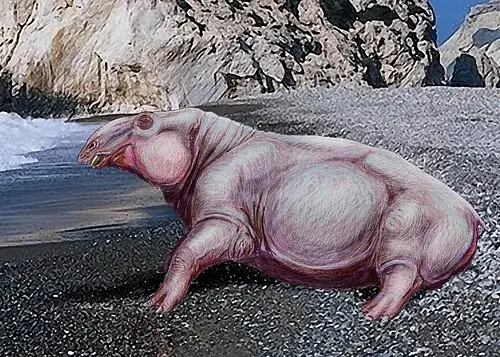
 🎨 Restoration
Restoration: Dmitry Bogdanov · CC BY 3.0 · Wikimedia Commons Source
Life restorations are artistic reconstructions based on fossil evidence; true coloration and soft-tissue details remain uncertain.
Desmostylus
Desmostylus hesperus (Desmostylus · Desmostylus)
Known only from fossils. The IUCN Red List assesses only species extant since 1500 CE, so fossil taxa are not assigned a category.
💡 Everyday Comparisons for Size, Mass & Speed
- 💡 A reconstructed body length of 2.71 m is about 3/4 of the length of a compact car (about 3.6 m) (Comparison).
- 💡 Papers explain that because it ate seagrass, it likely competed for the same resources as sirenians such as modern dugongs and manatees.
- 💡 A 2026 paper re-examined the arm bone of a juvenile Desmostylus (NMNS-PV 44111) found in the Chikubetsu Formation in Hokkaido, Japan.
Reference standards: coach bus ~12 m, mid-size car ~4.9 m, compact car ~1 t, basketball hoop 3.05 m, credit card 8.56 cm.
📖 1. Overview
Desmostylus hesperus (genus Desmostylus) was a four-legged herbivorous marine mammal that lived in the North Pacific from the Oligocene to the Miocene. Fossils of this genus are found in strata along the coasts of Japan, Sakhalin in Russia, and the western United States.
🦴 2. Anatomy & Morphology
The family Desmostylidae, to which this genus belongs, is characterized by having seven or more large cusps on the third upper molar. The body length reconstructed from subadult to adult specimens is 2.71 m.
🔍 3. Fossil Record & Paleoecology
Carbon isotope analysis shows that it grazed on seagrass, meaning it used the same food source as modern sirenians (dugongs and manatees). One researcher proposed that this genus disappeared during the Late Miocene cooling period about 11 million years ago.
🇰🇷 4. Connection to Korea
No direct record connecting this species to Korea has been found.
📚 Sources & References
- • Fossil taxon — the IUCN Red List assesses only species living or extinct since 1500
- • paleobiodb.org — basicTaxonInfo
- • wikidata.org — Q106432740
- • commons.wikimedia.org — File:Desmostylus2DB.jpg
- • ebi.ac.uk — fullTextXML
- • ebi.ac.uk — fullTextXML
- • Silhouette: PhyloPic — Steven Traver · CC0 1.0 (Congeneric silhouette — Desmostylus)
Recorded dimensions are widely cited representative estimates from public literature and may vary by study or specimen.