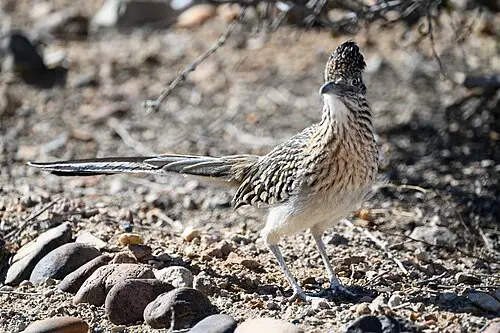
 📸 Photo
Photo: Gordon Leggett · CC BY 4.0 · Wikimedia Commons Source
Greater Roadrunner
Geococcyx californianus (Greater Roadrunner · オオミチバシリ)
💡 Everyday Comparisons for Size, Mass & Speed
- 💡 Its speed of about 27 km/h is equivalent to running 100 m in about 13 seconds (Comparison). Its weight of 341 g is about five and a half chicken eggs (about 60 g each) (Comparison).
- 💡 It helps eliminate pests such as mice and insects, and its curious behavior of not shying away from approaching humans makes it an engaging sight.
Reference standards: coach bus ~12 m, mid-size car ~4.9 m, compact car ~1 t, basketball hoop 3.05 m, credit card 8.56 cm.
Site-computed relative index from recorded values; not a formal scientific metric.
📖 1. Overview
The Greater Roadrunner is a bird in the cuckoo family living in the arid regions of southwestern North America that prefers walking or running to flying.
🦴 2. Anatomy & Morphology
Its head, neck, back, and wings are dark brown heavily streaked with white, its breast is white, and its eyes are yellow. It has a black feather crest that can be raised or lowered at will, blue legs and beak, and zygodactyl feet with two toes pointing forward and two backward.
🔍 3. Ecology & Behavior
It is an omnivore that eats large insects, scorpions, tarantulas, centipedes, lizards, snakes, and mice, walking rapidly to scan for prey before dashing in or leaping into the air to snatch it. It courts a mate by holding a lizard or snake in its beak, and uses its long tail for steering, braking, and balancing.
🇰🇷 4. Connection to Korea
No direct record connecting this species to Korea has been found.
📚 Sources & References
- • IUCN Red List LC (2022) — https://www.iucnredlist.org/species/22684458/152321922
- • IUCN Red List category LC — latest assessment at iucnredlist.org
- • doi.org — avilist.v2026
- • iucnredlist.org — 152321922
- • wikidata.org — Q634804
- • commons.wikimedia.org — File:2025-02-02 01 Greater roadrunner (Geococcyx californian
- • animaldiversity.org — Geococcyx californianus
- • Silhouette: PhyloPic — Nicolas Huet le Jeune and Jean-Gabriel Prêtre (vectorized by T. Michael Keesey) · Public Domain Mark 1.0 (Related taxon silhouette — Neomorphus geoffroyi)
Recorded dimensions are widely cited representative estimates from public literature and may vary by study or specimen.