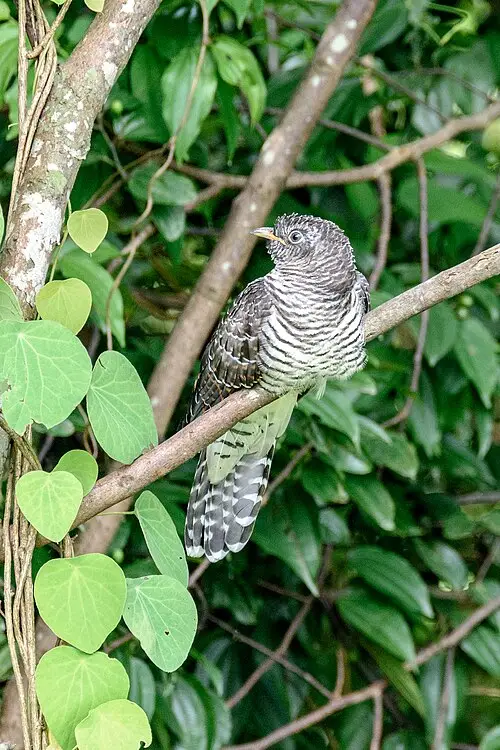
 📸 Photo
Photo: Creepanta · CC BY-SA 4.0 · Wikimedia Commons Source
Indian Cuckoo
Cuculus micropterus (Indian Cuckoo · セグロカッコウ)
💡 Everyday Comparisons for Size, Mass & Speed
- 💡 Because its 4-syllable 'ho ho ho ho' call is easy to recognize, it can be identified by sound in summer woods even when out of sight.
- 💡 In Korea it is an uncommon summer visitor that breeds in deciduous forests, larch forests, and mixed forests.
Reference standards: coach bus ~12 m, mid-size car ~4.9 m, compact car ~1 t, basketball hoop 3.05 m, credit card 8.56 cm.
📖 1. Overview
The Indian cuckoo is a brood-parasitic bird like the common cuckoo, breeding in southeastern Russia and China and wintering in Southeast Asia.
🦴 2. Anatomy & Morphology
Males have a dark grey head and neck and a greyish-brown back and rump. The lower breast and belly are white with sparse black crossbars, the tail has a distinct black band near the tip and a white tip, and the legs are yellow.
🔍 3. Ecology & Behavior
It mainly eats insects and usually lives alone. Its distinctive 4-syllable 'ho ho ho ho' call makes it easy to tell apart, with the final syllable softer and lower.
🇰🇷 4. Connection to Korea
It is listed on the National List of Species of Korea as an uncommon summer visitor that breeds on the Korean Peninsula.
📚 Sources & References
- • IUCN Red List LC (2018) — https://www.iucnredlist.org/species/22683870/130085980
- • IUCN Red List category LC — latest assessment at iucnredlist.org
- • doi.org — avilist.v2026
- • iucnredlist.org — 130085980
- • 국가생물종목록(국립생물자원관) ktsn 120000001838 — https://species.nibr.go.kr/home/mainHome.do?cont_link=009&subMenu=009002&contCd=009002&ktsn=120000001838
- • wikidata.org — Q877666
- • commons.wikimedia.org — File:Indian cuckoo (Cuculus micropterus) 46.jpg
- • species.nibr.go.kr — mainHome.do
- • Silhouette: PhyloPic — Nicolas Huet le Jeune and Jean-Gabriel Prêtre (vectorized by T. Michael Keesey) · Public Domain Mark 1.0 (Related taxon silhouette — Neomorphus geoffroyi)
Recorded dimensions are widely cited representative estimates from public literature and may vary by study or specimen.