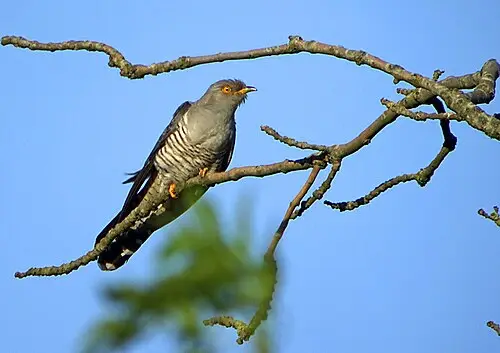
 📸 Photo
Photo: GabrielBuissart · CC BY-SA 3.0 · Wikimedia Commons Source
Common Cuckoo
Cuculus canorus (Common Cuckoo · カッコウ)
💡 Everyday Comparisons for Size, Mass & Speed
- 💡 Its mass of 130 g is similar to the weight of two chicken eggs (about 60 g each) (Comparison).
- 💡 By favoring hairy garden moth caterpillars it helps keep crop-damaging insects in check, and its 'ppeokkuk ppeokkuk' call from treetops or utility wires can be heard from early May (month 5).
Reference standards: coach bus ~12 m, mid-size car ~4.9 m, compact car ~1 t, basketball hoop 3.05 m, credit card 8.56 cm.
Site-computed relative index from recorded values; not a formal scientific metric.
📖 1. Overview
The common cuckoo is a brood-parasitic bird that lays its eggs in the nests of other birds; it is distributed across Eurasia, Africa, and Southeast Asia and visits all parts of Korea.
🦴 2. Anatomy & Morphology
Males have a grey body, a white belly with fine dark bars, and yellow eyes and eye-rings. Females come in two morphs—one similar to males and one reddish-brown—and have a long tail of 13–15 cm.
🔍 3. Ecology & Behavior
Because cuckoos visiting Korea lay blue eggs, a female mainly places 1 egg at a time in the nests of blue-egg hosts such as Bulgeunmeori-omoknuni (a Korean animal name) or Metsae (a Korean animal name), removing 1 host egg beforehand. It eats insects including hairy caterpillars that other birds avoid, and females also eat host eggs and chicks.
🇰🇷 4. Connection to Korea
It is listed on the National List of Species of Korea as occurring nationwide and begins calling 'ppeokkuk ppeokkuk' from early May (month 5).
📚 Sources & References
- • IUCN Red List LC (2024) — https://www.iucnredlist.org/species/22683873/264553575
- • IUCN Red List category LC — latest assessment at iucnredlist.org
- • doi.org — avilist.v2026
- • iucnredlist.org — 264553575
- • 국가생물종목록(국립생물자원관) ktsn 120000001839 — https://species.nibr.go.kr/home/mainHome.do?cont_link=009&subMenu=009002&contCd=009002&ktsn=120000001839
- • wikidata.org — Q18845
- • commons.wikimedia.org — File:Cuculus canorus2.jpg
- • species.nibr.go.kr — mainHome.do
- • animaldiversity.org — Cuculus canorus
- • Silhouette: PhyloPic — Nicolas Huet le Jeune and Jean-Gabriel Prêtre (vectorized by T. Michael Keesey) · Public Domain Mark 1.0 (Related taxon silhouette — Neomorphus geoffroyi)
Recorded dimensions are widely cited representative estimates from public literature and may vary by study or specimen.