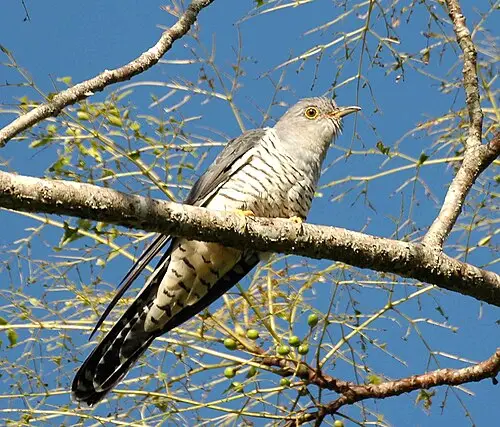
 📸 Photo
Photo: Aviceda · CC BY-SA 3.0 · Wikimedia Commons Source
Oriental Cuckoo
Cuculus optatus (Oriental Cuckoo · ツツドリ)
💡 Everyday Comparisons for Size, Mass & Speed
- 💡 Its maximum body length of 34 cm is slightly longer than the long side of an A4 sheet of paper (29.7 cm), and its mass of 96 g is the weight of one and a half chicken eggs (Comparison).
- 💡 A bird guide from Shimizu Town in Hokkaido, Japan, describes it as 'similar in size to a pigeon' and notes that it can be seen in woods at the foot of Mount Mokoto, on village outskirts, and in windbreak forests.
- 💡 The Eastern Crowned Warbler and Siberian Blue Robin are cited in the same guide as examples of host species for its eggs.
Reference standards: coach bus ~12 m, mid-size car ~4.9 m, compact car ~1 t, basketball hoop 3.05 m, credit card 8.56 cm.
Site-computed relative index from recorded values; not a formal scientific metric.
📖 1. Overview
The Oriental cuckoo is a migratory cuckoo that breeds from Japan and Korea to Siberia and heads toward Southeast Asia and Australia for winter. It practices brood parasitism, laying its eggs in other birds' nests.
🦴 2. Anatomy & Morphology
A slender medium-to-large cuckoo, it has a smooth grey head and neck and bold black bars across a white breast and belly. Its back and wings are dark grey, its long tail has white crossbars, and its eye-ring, bill base, and feet are yellow. Some females are a reddish-brown morph.
🔍 3. Ecology & Behavior
Hiding among leaves where it is hard to spot, it drops to the ground to catch earthworms and insects. It lays its eggs in the nests of small birds such as leaf warblers (Phylloscopus).
🇰🇷 4. Connection to Korea
It is listed on the National List of Species of Korea (National Institute of Biological Resources (NIBR)) under the Korean name Beongeori-ppeokkugi (Korean name, Cuculus optatus), and field guides note that it breeds in Korea and Japan.
📚 Sources & References
- • IUCN Red List LC (2021) — https://www.iucnredlist.org/species/22734721/206409798
- • IUCN Red List category LC — latest assessment at iucnredlist.org
- • doi.org — avilist.v2026
- • iucnredlist.org — 206409798
- • 국가생물종목록(국립생물자원관) ktsn 120000155179 — https://species.nibr.go.kr/home/mainHome.do?cont_link=009&subMenu=009002&contCd=009002&ktsn=120000155179
- • wikidata.org — Q1266506
- • commons.wikimedia.org — File:Oriental Cuckoo front Maiala.JPG
- • nzbirdsonline.org.nz — oriental-cuckoo
- • town.koshimizu.hokkaido.jp — bird-detail.php
- • species.nibr.go.kr — mainHome.do
- • Silhouette: PhyloPic — Nicolas Huet le Jeune and Jean-Gabriel Prêtre (vectorized by T. Michael Keesey) · Public Domain Mark 1.0 (Related taxon silhouette — Neomorphus geoffroyi)
Recorded dimensions are widely cited representative estimates from public literature and may vary by study or specimen.