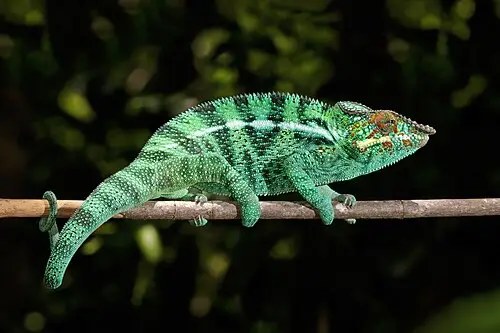
 📸 Photo
Photo: Charles J. Sharp · CC BY-SA 4.0 · Wikimedia Commons Source
Panther Chameleon
Furcifer pardalis (Panther Chameleon · パンサーカメレオン)
💡 Everyday Comparisons for Size, Mass & Speed
- 💡 Though rarely eaten by local people, it is captured and sold in the international pet trade, mainly going to the United States, Europe, and Asia (benefit to humans noted by ADW).
- 💡 Its maximum length of 23 cm is slightly longer than the short side of an A4 sheet (21 cm) (Comparison).
Reference standards: coach bus ~12 m, mid-size car ~4.9 m, compact car ~1 t, basketball hoop 3.05 m, credit card 8.56 cm.
📖 1. Overview
The Panther Chameleon is a chameleon living along the edges of lowland dry deciduous forests, famous for its strikingly vibrant body colors.
🦴 2. Anatomy & Morphology
Males are larger, have a swollen tail base, and show a wide variety of colors and patterns, whereas females are smaller and uniformly pale green or pinkish. By moving its two eyes independently to look at different objects, it can scan a full 360 degrees while remaining still.
🔍 3. Ecology & Behavior
An ambush hunter that waits for prey to pass within reach of its long tongue, it eats mainly terrestrial invertebrates and very rarely plant matter. Solitary and territorial regardless of age or sex, males are aggressive enough to severely injure intruding males.
🇰🇷 4. Connection to Korea
No direct record connecting this species to Korea has been found.
📚 Sources & References
- • IUCN Red List LC (2011) — https://www.iucnredlist.org/species/172955/6947909
- • IUCN Red List category LC — latest assessment at iucnredlist.org
- • catalogueoflife.org — 6K4Y8
- • iucnredlist.org — 6947909
- • wikidata.org — Q838578
- • commons.wikimedia.org — File:Panther chameleon (Furcifer pardalis) male Nosy Be.jpg
- • animaldiversity.org — Furcifer pardalis
- • Silhouette: PhyloPic — Ferran Sayol · CC0 1.0 (Congeneric silhouette — Furcifer rhinoceratus)
Recorded dimensions are widely cited representative estimates from public literature and may vary by study or specimen.