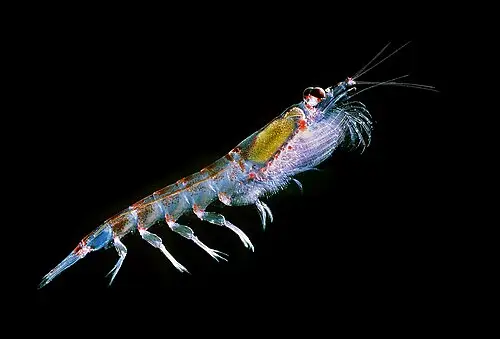
 📸 Photo
Photo: Krill666.jpg : Uwe Kils I am willing to give the image in 1700 resolution to Wikipedia Uwe Kils · CC BY-SA 3.0 · Wikimedia Commons Source
Antarctic krill
Euphausia superba (Antarctic krill · ナンキョクオキアミ)
💡 Everyday Comparisons for Size, Mass & Speed
- 💡 Its body length of 6.5 cm is similar to 2.5 Korean 500-won coins (diameter 26.5 mm) placed side by side (Comparison).
- 💡 A maximum swarm density of 30,000 individuals per 1 m³ works out to about 30 individuals in the volume of a 1 L water bottle (calculated at 1 m³ = 1,000 L, Comparison).
- 💡 Its average weight of 2 g per individual is about two-fifths the weight of a sheet of A4 paper (about 5 g for 80 g/m² paper) (Comparison).
Reference standards: coach bus ~12 m, mid-size car ~4.9 m, compact car ~1 t, basketball hoop 3.05 m, credit card 8.56 cm.
Site-computed relative index from recorded values; not a formal scientific metric.
📖 1. Overview
Antarctic krill is a small, shrimp-like crustacean living in swarms in the Southern Ocean and forms the center of the Antarctic marine food web.
🦴 2. Anatomy & Morphology
Its body is pinkish, somewhat transparent, and covered with a hard shell. It has light-producing organs (photophores) that glow blue.
🔍 3. Ecology & Behavior
It forms a feeding basket with its thoracic legs to filter phytoplankton from the water, and in winter it feeds heavily on algae growing beneath sea ice. It can survive up to 200 days without food, and swarm density can reach 30,000 individuals per 1 m³.
🇰🇷 4. Connection to Korea
No direct record connecting this species to Korea has been found.
📚 Sources & References
- • IUCN Red List LC (2015) — https://www.iucnredlist.org/species/64239743/64239951
- • IUCN Red List category LC — latest assessment at iucnredlist.org
- • marinespecies.org — aphia.php
- • iucnredlist.org — 64239951
- • wikidata.org — Q571443
- • commons.wikimedia.org — File:Antarctic krill (Euphausia superba).jpg
- • animaldiversity.org — Euphausia superba
- • antarctica.gov.au — krill
- • Silhouette: PhyloPic — Steven Haddock • Jellywatch.org · Public Domain Mark 1.0 (Congeneric silhouette — Euphausia pacifica)
Recorded dimensions are widely cited representative estimates from public literature and may vary by study or specimen.