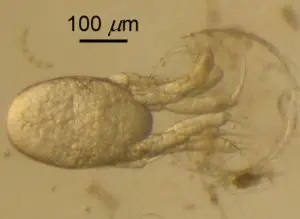
 📸 Photo
Photo: Dr. Jaime Gómez-Gutiérrez · CC BY-SA 3.0 · Wikimedia Commons Source
North Pacific krill
Euphausia pacifica (North Pacific krill · ツノナシオキアミ)
Not Evaluated (NE) on the IUCN Red List yet.
💡 Everyday Comparisons for Size, Mass & Speed
- 💡 A maximum adult body length of 25 mm is similar to the diameter of a Korean 100-won coin (about 24 mm) (Comparison).
- 💡 'Euphausiids of the World Ocean' on the Dutch Naturalis website notes that this species has been commercially fished in the East Sea and near Vancouver Island, Canada. It is a small shrimp-like crustacean that forms the base of the marine food chain for whales and seabirds.
Reference standards: coach bus ~12 m, mid-size car ~4.9 m, compact car ~1 t, basketball hoop 3.05 m, credit card 8.56 cm.
📖 1. Overview
The North Pacific krill is a species of krill living only in the North Pacific that forms large swarms and serves as an important food source for whales, fish, and seabirds.
🦴 2. Anatomy & Morphology
Its eyes are round and large, with an eye diameter about 0.21 times the carapace length. It lacks a rostrum (frontal horn), its short frontal plate forms a blunt triangle, and there is a pair of small denticles on either side of the carapace.
🔍 3. Ecology & Behavior
It makes strong vertical migrations, staying in deep water during the day (usually around 300 m deep, up to 1,000 m) and rising near the surface at night to feed. At night, within the upper 100 m, it filter-feeds on unicellular algae and other particles in the water, and is close to omnivorous in trophic level.
🇰🇷 4. Connection to Korea
It is listed under the name "Taepyeongyangnanbadagonjaengi" (Korean name) on the National List of Species of Korea, and is recorded as also inhabiting the East Sea.
📚 Sources & References
- • IUCN Red List: not evaluated (NE) — cross-checked with the Wikidata conservation-status entry
- • marinespecies.org — aphia.php
- • 국가생물종목록(국립생물자원관) ktsn 120000049446 — https://species.nibr.go.kr/home/mainHome.do?cont_link=009&subMenu=009002&contCd=009002&ktsn=120000049446
- • wikidata.org — Q992625
- • commons.wikimedia.org — File:Nauplius Hatching.jpg
- • euphausiids.linnaeus.naturalis.nl — taxon.php
- • sealifebase.se — Euphausia-pacifica.html
- • species.nibr.go.kr — mainHome.do
- • Silhouette: PhyloPic — Steven Haddock • Jellywatch.org · Public Domain Mark 1.0
Recorded dimensions are widely cited representative estimates from public literature and may vary by study or specimen.