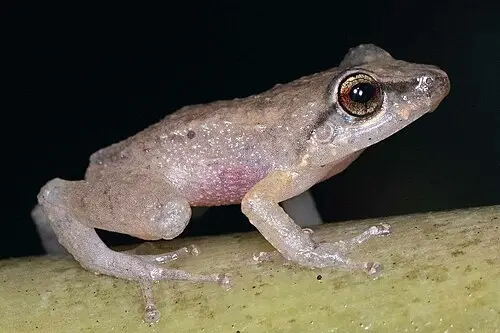
 📸 Photo
Photo: Casey H. Richart · CC BY 4.0 · Wikimedia Commons Source
Common Coquí
Eleutherodactylus coqui (Common Coquí · コキーコヤスガエル)
💡 Everyday Comparisons for Size, Mass & Speed
- 💡 Its body length of 5.5 cm is similar to two Korean 500-won coins placed side by side (about 5.3 cm) (Comparison).
- 💡 Living in human homes and parks, it can act as a 'live-in pest control agent' that catches pests like cockroaches and crickets (ADW, 'Positive Impacts').
Reference standards: coach bus ~12 m, mid-size car ~4.9 m, compact car ~1 t, basketball hoop 3.05 m, credit card 8.56 cm.
📖 1. Overview
The Common Coquí is the most common small tree frog in Puerto Rico, living not only in forests but also in homes and parks. Its name comes from the male's 'co-qui' call. It is listed as Least Concern (LC, 2021 assessment) on the IUCN Red List.
🦴 2. Anatomy & Morphology
At 24–55 mm in body length, it is the largest frog in Puerto Rico's forests, with females larger than males and individuals at higher elevations growing larger. It is light brown with gray or tan patterns, and large sticky pads under its unwebbed toes allow it to climb trees and leaves.
🔍 3. Ecology & Behavior
A nocturnal tree-climbing ambush hunter, it sits motionless on leaves until prey comes close, moving less than 5 cm to strike and eat cockroaches, crickets, ants, and spiders. The male's 'co' note is directed at other males while the 'qui' note attracts females, and eggs hatch directly into froglets without a tadpole stage.
🇰🇷 4. Connection to Korea
No direct record connecting this species to Korea has been found.
📚 Sources & References
- • IUCN Red List LC (2021) — https://www.iucnredlist.org/species/56522/3041672
- • IUCN Red List category LC — latest assessment at iucnredlist.org
- • catalogueoflife.org — 3996F
- • iucnredlist.org — 3041672
- • wikidata.org — Q616638
- • commons.wikimedia.org — File:Eleutherodactylus coqui 230762425.jpg
- • animaldiversity.org — Eleutherodactylus coqui
- • Silhouette: PhyloPic — Jose Carlos Arenas-Monroy · CC0 1.0 (Congeneric silhouette — Eleutherodactylus nitidus)
Recorded dimensions are widely cited representative estimates from public literature and may vary by study or specimen.