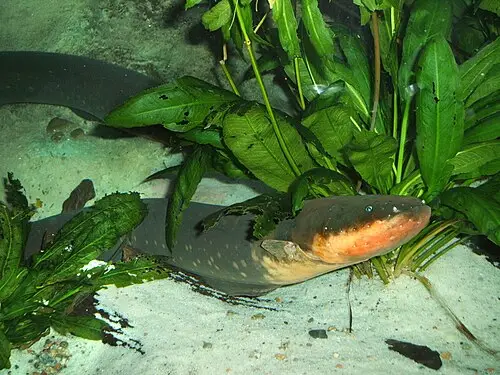
 📸 Photo
Photo: Steven G. Johnson · CC BY-SA 3.0 · Wikimedia Commons Source
Electric eel
Electrophorus electricus (Electric eel · デンキウナギ)
💡 Everyday Comparisons for Size, Mass & Speed
- 💡 A discharge of 500 V has been recorded from a 1 m individual, more than twice the voltage of household electricity in Korea (220 V) (Comparison).
- 💡 It is a flagship display fish in public aquariums (FishBase). Its maximum body length of 2.5 m is more than half the length of a passenger car (Comparison).
Reference standards: coach bus ~12 m, mid-size car ~4.9 m, compact car ~1 t, basketball hoop 3.05 m, credit card 8.56 cm.
Site-computed relative index from recorded values; not a formal scientific metric.
📖 1. Overview
The Electric eel is a large fish living in swamps and creeks of South America that generates strong electricity from its body.
🦴 2. Anatomy & Morphology
It has electric organs made up of hundreds of thousands of electricity-producing cells (electrocytes) connected in series. It uses weak electricity (about 10 V) to sense its surroundings and electricity about 50 times stronger to hunt prey.
🔍 3. Ecology & Behavior
Juveniles feed on invertebrates, while adults eat fish and small mammals. First-hatched young also feed on later-laid eggs and embryos.
🇰🇷 4. Connection to Korea
No direct record connecting this species to Korea has been found.
📚 Sources & References
- • IUCN Red List LC (2023) — https://www.iucnredlist.org/species/167700/53826515
- • IUCN Red List category LC — latest assessment at iucnredlist.org
- • catalogueoflife.org — 396VZ
- • iucnredlist.org — 53826515
- • wikidata.org — Q201235
- • commons.wikimedia.org — File:Electric-eel.jpg
- • fishbase.se — Electrophorus-electricus.html
- • Silhouette: PhyloPic — Neil Kelley · CC0 1.0
Recorded dimensions are widely cited representative estimates from public literature and may vary by study or specimen.