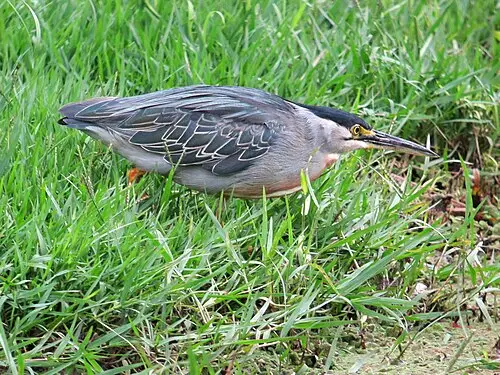
 📸 Photo
Photo: Félix Uribe from Rionegro, Antioquia, Colombia · CC BY-SA 2.0 · Wikimedia Commons Source
Striated Heron
Butorides striata (Striated Heron · ササゴイ)
💡 Everyday Comparisons for Size, Mass & Speed
- 💡 Its body length of about 52 cm is around two-thirds (2/3) the length of a long umbrella (Comparison).
- 💡 A bird standing motionless for a long while along a summer mountain valley or small stream may be this species waiting to strike at fish (National List of Species of Korea).
- 💡 Unlike other herons that nest in colonies, it nests alone in forests, so its breeding sites do not easily stand out (National List of Species of Korea).
Reference standards: coach bus ~12 m, mid-size car ~4.9 m, compact car ~1 t, basketball hoop 3.05 m, credit card 8.56 cm.
📖 1. Overview
The striated heron is a small heron that lives solitarily along mountain valleys and streams. It is widely distributed across Africa, Asia, Australia, southern North America, and South America.
🦴 2. Anatomy & Morphology
From the crown to the back of the neck it is bluish-black, with a black crest projecting from the back of the head. Its body is grey with white and black vertical stripes down the center of the breast.
🔍 3. Ecology & Behavior
It stands motionless for a long time in mountain streams before swiftly snatching fish with its pointed bill. Unlike other herons, it does not breed in colonies, instead building a saucer-shaped nest in forest trees and laying 4–5 bluish-green eggs.
🇰🇷 4. Connection to Korea
It is a common summer visitor observed nationwide from April (month 4) to September (month 9).
📚 Sources & References
- • IUCN Red List LC (2022) — https://www.iucnredlist.org/species/22728182/163804848
- • IUCN Red List category LC — latest assessment at iucnredlist.org
- • doi.org — avilist.v2026
- • iucnredlist.org — 163804848
- • 국가생물종목록(국립생물자원관) ktsn 120000001535 — https://species.nibr.go.kr/home/mainHome.do?cont_link=009&subMenu=009002&contCd=009002&ktsn=120000001535
- • wikidata.org — Q270722
- • commons.wikimedia.org — File:Butorides striata Garcita rayada Striated Heron (654935
- • species.nibr.go.kr — mainHome.do
- • Silhouette: PhyloPic — Andy Wilson · CC0 1.0 (Congeneric silhouette — Butorides virescens)
Recorded dimensions are widely cited representative estimates from public literature and may vary by study or specimen.