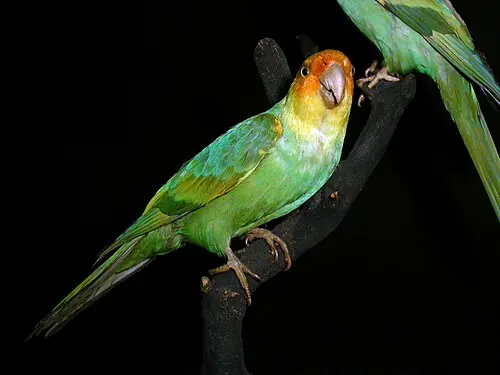
 📸 Photo
Photo: Fritz Geller-Grimm · CC BY-SA 2.5 · Wikimedia Commons Source
Carolina Parakeet
Conuropsis carolinensis (Carolina Parakeet · カロライナインコ)
💡 Everyday Comparisons for Size, Mass & Speed
- 💡 Its body length of 34 cm was slightly longer than the long side of an A4 sheet of paper (29.7 cm), and its mass of 280 g was about four or five chicken eggs (about 60 g each) (Comparison).
- 💡 It was kept as a pet, eaten, and traded for its feathers, and being hunted in whole flocks as an orchard pest is cited as one of the reasons it vanished.
Reference standards: coach bus ~12 m, mid-size car ~4.9 m, compact car ~1 t, basketball hoop 3.05 m, credit card 8.56 cm.
Site-computed relative index from recorded values; not a formal scientific metric.
📖 1. Overview
The Carolina parakeet was a green parrot that lived in the temperate forests of eastern North America and is now Extinct (EX). It lived in large flocks inside hollow trees in swamps and along rivers.
🦴 2. Anatomy & Morphology
Its body was mostly green with yellow shoulders, and its most distinctive feature was its orange forehead and face. The skin around its eyes was white and its bill was pale flesh-colored.
🔍 3. Ecology & Behavior
It mainly ate cocklebur seeds along with fruits, flower buds, and insects. Because of its social habit of flocking in groups of 100–1,000 birds, when one bird was shot its flockmates hovered overhead and were hunted down en masse, and farmers shot entire flocks to protect crops.
🇰🇷 4. Connection to Korea
No direct record connecting this species to Korea has been found.
📚 Sources & References
- • IUCN Red List EX (2021) — https://www.iucnredlist.org/species/22685776/195444267
- • IUCN Red List category EX — latest assessment at iucnredlist.org
- • doi.org — avilist.v2026
- • iucnredlist.org — 195444267
- • wikidata.org — Q629204
- • commons.wikimedia.org — File:Karolinasittich 01.jpg
- • animaldiversity.org — Conuropsis carolinensis
- • Silhouette: PhyloPic — Ferran Sayol · CC0 1.0 (Related taxon silhouette — Amazona aestiva)
Recorded dimensions are widely cited representative estimates from public literature and may vary by study or specimen.