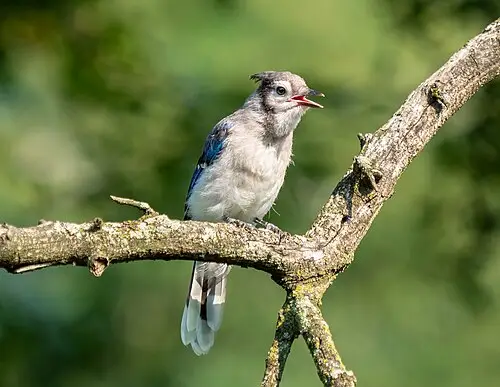
 📸 Photo
Photo: Rhododendrites · CC BY-SA 4.0 · Wikimedia Commons Source
Blue Jay
Cyanocitta cristata (Blue Jay · アオカケス)
💡 Everyday Comparisons for Size, Mass & Speed
- 💡 It is commonly seen in suburban yards and city parks (ADW).
- 💡 Its mass of 109 g is about the weight of 14 Korean 500-won coins (7.7 g each) (Comparison).
- 💡 Captive individuals have been recorded making tools to reach food (ADW).
Reference standards: coach bus ~12 m, mid-size car ~4.9 m, compact car ~1 t, basketball hoop 3.05 m, credit card 8.56 cm.
Site-computed relative index from recorded values; not a formal scientific metric.
📖 1. Overview
The blue jay is a bright blue bird of the crow family living in forests and urban parks of eastern North America, known for being noisy and bold.
🦴 2. Anatomy & Morphology
Its back is bright blue, its belly and chin are greyish-white, and it has a greyish-blue crest that can be raised or lowered. Its wings and tail are blue with white and black bars, and a black necklace pattern runs from the throat around the head.
🔍 3. Ecology & Behavior
It eats fruits, nuts, seeds, insects, mice, and frogs, sometimes robs other birds' nests for eggs or chicks, and holds nuts with its feet to crack them open with its bill. It caches food, and in autumn some individuals migrate in flocks of over a hundred birds.
🇰🇷 4. Connection to Korea
No direct record connecting this species to Korea has been found.
📚 Sources & References
- • IUCN Red List LC (2025) — https://www.iucnredlist.org/species/22705611/137739324
- • IUCN Red List category LC — latest assessment at iucnredlist.org
- • doi.org — avilist.v2026
- • iucnredlist.org — 137739324
- • wikidata.org — Q199758
- • commons.wikimedia.org — File:Blue jay fledgling (53513).jpg
- • animaldiversity.org — Cyanocitta cristata
- • Silhouette: PhyloPic — Caleb M. Gordon · CC0 1.0
Recorded dimensions are widely cited representative estimates from public literature and may vary by study or specimen.