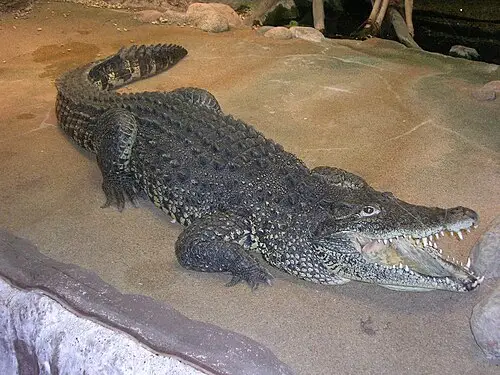
 📸 Photo
Photo: Eric Mas Casas · CC BY 3.0 · Wikimedia Commons Source
Cuban Crocodile
Crocodylus rhombifer (Cuban Crocodile · キューバワニ)
💡 Everyday Comparisons for Size, Mass & Speed
- 💡 Its maximum length of 3.5 m is about 3/4 the length of a passenger car (about 4.5 m) (Comparison).
- 💡 Its hide has been sold for products such as wallets, boots, and briefcases, and its meat as a delicacy (benefit to humans noted by ADW).
- 💡 At the Smithsonian's National Zoo, it is fed crocodile pellets, rats, rabbits, and occasionally fish (Smithsonian's National Zoo).
Reference standards: coach bus ~12 m, mid-size car ~4.9 m, compact car ~1 t, basketball hoop 3.05 m, credit card 8.56 cm.
📖 1. Overview
The Cuban Crocodile has the smallest distribution range of any crocodile, living only in two swamps in Cuba. Its IUCN status is Critically Endangered (CR) as of 2022.
🦴 2. Anatomy & Morphology
It has a short, broad head with a bony ridge behind the eyes, and a black and olive body scattered with yellow speckles. The dorsal armor plates extend onto the neck, and the scales on the hind legs are heavily keeled.
🔍 3. Ecology & Behavior
Juveniles eat invertebrates and small fish, while adults eat fish, turtles, and small mammals, and can even leap from the water to snatch birds and arboreal mammals from tree branches. It breeds for three to four months starting in May and lays 30–40 eggs at a time.
🇰🇷 4. Connection to Korea
No direct record connecting this species to Korea has been found.
📚 Sources & References
- • IUCN Red List CR (2022) — https://www.iucnredlist.org/species/5670/130856048
- • IUCN Red List category CR — latest assessment at iucnredlist.org
- • catalogueoflife.org — ZKNR
- • iucnredlist.org — 130856048
- • wikidata.org — Q242102
- • commons.wikimedia.org — File:Estocolm 2008 163.jpg
- • nationalzoo.si.edu — cuban-crocodile
- • animaldiversity.org — Crocodylus rhombifer
- • Silhouette: PhyloPic — Becky Barnes · CC0 1.0 (Congeneric silhouette — Crocodylus)
Recorded dimensions are widely cited representative estimates from public literature and may vary by study or specimen.