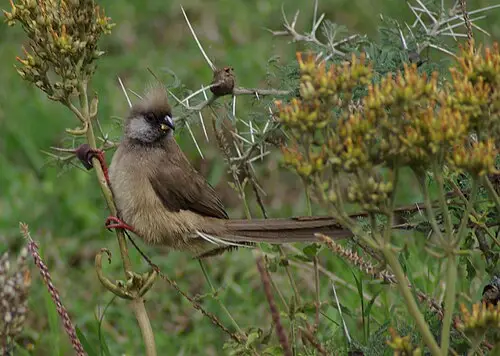
 📸 Photo
Photo: JerryFriedman · CC BY-SA 3.0 · Wikimedia Commons Source
Speckled Mousebird
Colius striatus (Speckled Mousebird · チャイロネズミドリ)
💡 Everyday Comparisons for Size, Mass & Speed
- 💡 It is counted among the birds commonly seen in residential gardens in Cape Town (University of Cape Town 'Biodiversity Observations' garden bird guide).
- 💡 An adult's mass of about 51 g is lighter than one chicken egg (about 60 g) (Comparison).
Reference standards: coach bus ~12 m, mid-size car ~4.9 m, compact car ~1 t, basketball hoop 3.05 m, credit card 8.56 cm.
Site-computed relative index from recorded values; not a formal scientific metric.
📖 1. Overview
The speckled mousebird is a medium-sized bird common in South Africa, Mozambique, and eastern Zimbabwe, adapting to habitats ranging from forest edges to suburban gardens. Usually 5–20 birds forage together in trees.
🦴 2. Anatomy & Morphology
Its upperparts are sandy brown and its underparts are a warmer brown, with long brown tail feathers and a sandy-brown crest. Its bill is black above and whitish below, and males and females look alike.
🔍 3. Ecology & Behavior
It mainly eats plant food such as mistletoe berries along with leaves, flowers, buds, and nectar. A cooperative breeder, a pair is assisted by 2–6 young helpers, and both parents incubate the 1–7 eggs for 12–15 days.
🇰🇷 4. Connection to Korea
No direct record connecting this species to Korea has been found.
📚 Sources & References
- • IUCN Red List LC (2024) — https://www.iucnredlist.org/species/22683776/263660058
- • IUCN Red List category LC — latest assessment at iucnredlist.org
- • doi.org — avilist.v2026
- • iucnredlist.org — 263660058
- • wikidata.org — Q875885
- • commons.wikimedia.org — File:Colius striatus1.jpg
- • genomics.senescence.info — entry.php
- • biodiversityexplorer.info — colius striatus.htm
- • journals.uct.ac.za — 7012
- • Silhouette: PhyloPic — Enoch Joseph Wetsy (photo), John E. McCormack, Michael G. Harvey, Brant C. Faircloth, Nicholas G. Crawford, Travis C. Glenn, Robb T. Brumfield & T. Michael Keesey · CC BY 3.0 (Related taxon silhouette — Urocolius indicus)
Recorded dimensions are widely cited representative estimates from public literature and may vary by study or specimen.