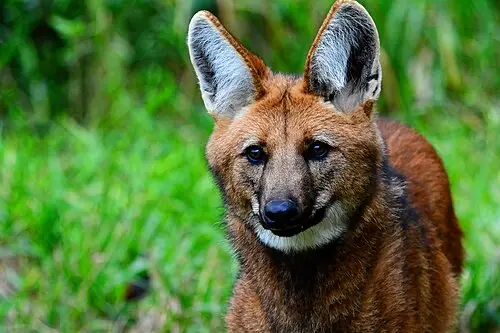
 📸 Photo
Photo: Ferrarezi Jr. · CC BY-SA 4.0 · Wikimedia Commons Source
Maned Wolf
Chrysocyon brachyurus (Maned Wolf · タテガミオオカミ)
💡 Everyday Comparisons for Size, Mass & Speed
- 💡 Its shoulder height of about 90 cm is taller than a dining table (around 75 cm), and its weight of about 23 kg is slightly heavier than a 20 kg bag of rice (Comparison).
- 💡 Fruits (such as lobeira) make up half its diet, and by also eating rabbits and rodents it helps reduce crop pests (ADW, Smithsonian).
Reference standards: coach bus ~12 m, mid-size car ~4.9 m, compact car ~1 t, basketball hoop 3.05 m, credit card 8.56 cm.
Site-computed relative index from recorded values; not a formal scientific metric.
📖 1. Overview
The Maned Wolf is the largest canid in South America. Living in grasslands with tall grass, it looks more like a long-legged fox than a wolf. It is a distinct species that is neither a true wolf nor a fox.
🦴 2. Anatomy & Morphology
It has reddish-golden fur, with the lower legs grading from red to black and the front of the mane also black. It has a narrow body, long slender legs, and large erect ears. Its long legs are thought to help it see over tall grass.
🔍 3. Ecology & Behavior
It is omnivorous, with fruits—including the tomato-like lobeira ('wolf's fruit')—making up 50% of its diet. It also eats rabbits, rodents, birds, fish, and insects. It hunts alone at night and dusk, and a pair uses an average territory of 27 km².
🇰🇷 4. Connection to Korea
No direct record connecting this species to Korea has been found.
📚 Sources & References
- • IUCN Red List NT (2015) — https://www.iucnredlist.org/species/4819/88135664
- • IUCN Red List category NT — latest assessment at iucnredlist.org
- • mammaldiversity.org — 1005948
- • iucnredlist.org — 88135664
- • wikidata.org — Q184389
- • commons.wikimedia.org — File:Chrysocyon brachyurus no Parque Nacional da Serra da Ca
- • animaldiversity.org — Chrysocyon brachyurus
- • nationalzoo.si.edu — maned-wolf
- • Silhouette: PhyloPic — Margot Michaud · CC0 1.0
Recorded dimensions are widely cited representative estimates from public literature and may vary by study or specimen.