 📸 Photo
Photo: Brian Adler ( BrianAdler ) · Public domain · Wikimedia Commons Source
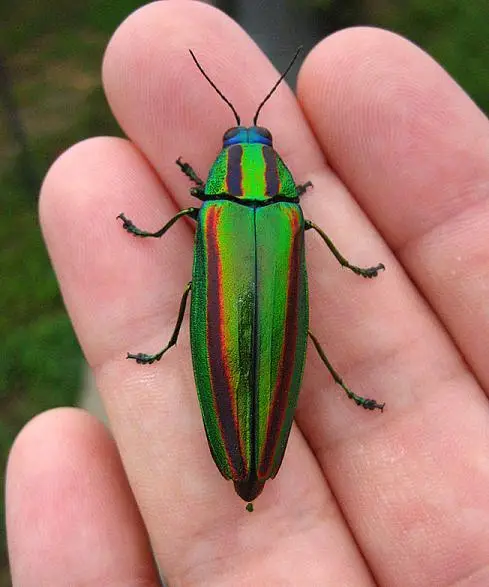
Japanese jewel beetle
Chrysochroa fulgidissima (Japanese jewel beetle · タマムシ)
Not Evaluated (NE) on the IUCN Red List yet.
💡 Everyday Comparisons for Size, Mass & Speed
- 💡 Its body length of 40 mm is about 1.5 times a Korean 500-won coin (diameter 26.5 mm) (Comparison).
- 💡 The species called 'Bi-dan-beol-re' (Korean name) in Korea is listed on the National List of Species of Korea as Chrysochroa coreana and is a Class I endangered wildlife (Korea).
Reference standards: coach bus ~12 m, mid-size car ~4.9 m, compact car ~1 t, basketball hoop 3.05 m, credit card 8.56 cm.
📖 1. Overview
The Japanese jewel beetle is a large jewel beetle with a gleaming green body, and materials from the Rural Development Administration record its distribution in Japan and Taiwan.
🦴 2. Anatomy & Morphology
It is 25–40 mm long with a glossy green body and red stripes on the pronotum and elytra. Its antennae are serrated and its compound eyes are dark brown.
🔍 3. Ecology & Behavior
Adults can be seen from July to September and fly around branch tips during the day. Females lay eggs on dead branches of hackberry and zelkova trees.
🇰🇷 4. Connection to Korea
Materials from the Rural Development Administration introduce 'Bi-dan-beol-re' (Korean name) under this scientific name and list its domestic distribution as nationwide, whereas the Korean 'Bi-dan-beol-re' on the National List of Species of Korea is listed separately as Chrysochroa coreana (Class I endangered wildlife (Korea)).
📚 Sources & References
- • IUCN Red List: not evaluated (NE) — cross-checked with the Wikidata conservation-status entry
- • catalogueoflife.org — 5YNWF
- • wikidata.org — Q1952770
- • commons.wikimedia.org — File:Chrysochroa Fulgidissima (Tamamushi) In Hand.PNG
- • genebank.rda.go.kr — insectView.bo
- • Silhouette: PhyloPic — Crystal Maier · CC BY 3.0 (Related taxon silhouette — Buprestidae)
Recorded dimensions are widely cited representative estimates from public literature and may vary by study or specimen.