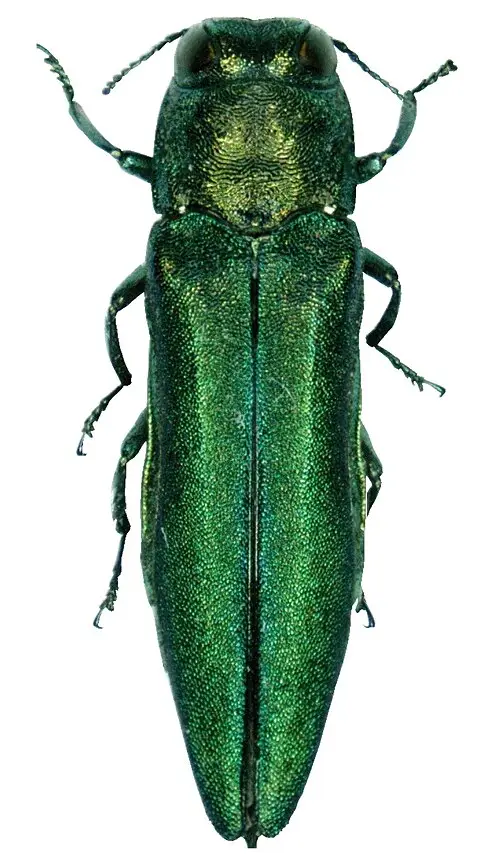
 📸 Photo
Photo: Pennsylvania Department of Conservation and Natural Resources - Forestry Archive · CC BY 3.0 us · Wikimedia Commons Source
Emerald ash borer
Agrilus planipennis (Emerald ash borer · アオナガタマムシ)
Not Evaluated (NE) on the IUCN Red List yet.
💡 Everyday Comparisons for Size, Mass & Speed
- 💡 A body length of 13.5 mm is three-quarters the diameter of a Korean 10-won coin (18 mm) (Comparison).
- 💡 ADW notes that ash trees are widely planted as urban landscaping trees and agricultural windbreaks, and that this beetle kills those trees.
Reference standards: coach bus ~12 m, mid-size car ~4.9 m, compact car ~1 t, basketball hoop 3.05 m, credit card 8.56 cm.
📖 1. Overview
The emerald ash borer (Seoulhoribidanbeolle, Korean name) is a pest that kills ash trees; it is native to the Korean Peninsula, China, and Japan, and has been introduced into and spread across Canada and the United States.
🦴 2. Anatomy & Morphology
Its body is emerald green and elongated-cylindrical, measuring about 9.5–13.5 mm in length. Its antennae are long enough to reach the middle of the pronotum and are serrated from the 4th segment onward.
🔍 3. Ecology & Behavior
According to ADW, adults eat ash leaves while larvae bore into the cambium layer beneath the bark, killing the tree. Adults can fly up to 2.8 km per day and up to about 10 km in a single flight.
🇰🇷 4. Connection to Korea
The National List of Species of Korea records its distribution on the Korean Peninsula (Gyeonggi-do, Gangwon-do, Chungcheongnam-do, and North Korea) and notes that its larvae parasitize ash, walnut, elm, and wingnut trees.
📚 Sources & References
- • IUCN Red List: not evaluated (NE) — cross-checked with the Wikidata conservation-status entry
- • catalogueoflife.org — B6DS
- • 국가생물종목록(국립생물자원관) ktsn 120000014084 — https://species.nibr.go.kr/home/mainHome.do?cont_link=009&subMenu=009002&contCd=009002&ktsn=120000014084
- • wikidata.org — Q1960177
- • commons.wikimedia.org — File:Agrilus planipennis 001.jpg
- • species.nibr.go.kr — mainHome.do
- • animaldiversity.org — Agrilus planipennis
- • Silhouette: PhyloPic — Crystal Maier · CC BY 3.0 (Related taxon silhouette — Buprestidae)
Recorded dimensions are widely cited representative estimates from public literature and may vary by study or specimen.