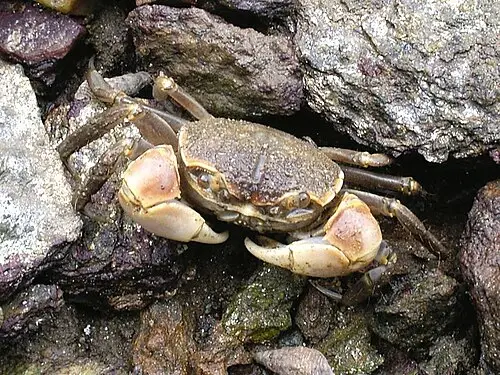
 📸 Photo
Photo: ふうけ · Public domain · Wikimedia Commons Source
Chasmagnathus convexus
Chasmagnathus convexus (Chasmagnathus convexus · ハマガニ)
Not Evaluated (NE) on the IUCN Red List yet.
🇰🇷 Class II endangered wildlife (Korea)
💡 Everyday Comparisons for Size, Mass & Speed
- 💡 Its carapace length of 4 cm is about 1.5 times the diameter of a Korean 500-won coin (26.5 mm) (Comparison).
- 💡 Habitat development along with dumping household waste is cited as a major threat to this crab.
Reference standards: coach bus ~12 m, mid-size car ~4.9 m, compact car ~1 t, basketball hoop 3.05 m, credit card 8.56 cm.
📖 1. Overview
Chasmagnathus convexus is a purplish crab that digs burrows in upper grasslands along coasts with well-developed tidal flats and in estuarine ditches.
🦴 2. Anatomy & Morphology
Its carapace is quadrangular with convex sides, the body is purplish overall, and there is a deep longitudinal groove on the back. Males have larger claws than females, both claws are similar in size, and closing the pincers leaves a figure-8-shaped gap.
🔍 3. Ecology & Behavior
It mainly eats carcasses of various organisms and organic matter. Egg-bearing females are seen from June to September, but because its numbers are small, its breeding habits are not well known.
🇰🇷 4. Connection to Korea
In Korea, it is a Class II endangered wildlife (Korea). In the past it was recorded around tidal flats nationwide, but recently it is found only in parts of the southern coast and Jeju Island.
📚 Sources & References
- • 멸종위기 야생생물 Ⅱ급 — 국가생물종목록(국립생물자원관) ktsn 120000048879 — https://species.nibr.go.kr/home/mainHome.do?cont_link=009&subMenu=009002&contCd=009002&ktsn=120000048879
- • IUCN Red List: not evaluated (NE) — cross-checked with the Wikidata conservation-status entry
- • Korean protection status: Class II endangered wildlife (Korea)
- • marinespecies.org — aphia.php
- • 국가생물종목록(국립생물자원관) ktsn 120000048879 — https://species.nibr.go.kr/home/mainHome.do?cont_link=009&subMenu=009002&contCd=009002&ktsn=120000048879
- • wikidata.org — Q5087374
- • commons.wikimedia.org — File:Hamagani0811.jpg
- • nie.re.kr — view.do
- • species.nibr.go.kr — general-search
- • Silhouette: PhyloPic — Polina Drozdova · CC0 1.0 (Related taxon silhouette — Eriocheir sinensis)
Recorded dimensions are widely cited representative estimates from public literature and may vary by study or specimen.