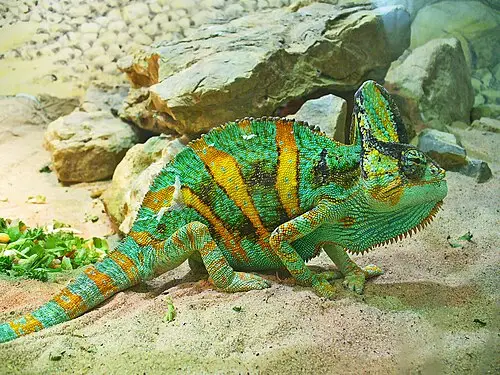
 📸 Photo
Photo: H. Zell · CC BY-SA 3.0 · Wikimedia Commons Source
Veiled Chameleon
Chamaeleo calyptratus (Veiled Chameleon · エボシカメレオン)
💡 Everyday Comparisons for Size, Mass & Speed
- 💡 Live and dead individuals are sold as ritual objects and souvenirs (benefit to humans noted by ADW).
- 💡 A male's maximum body length of 24 inches (about 61 cm) equals two 30 cm rulers placed end to end (Comparison).
- 💡 A clutch of 35–85 eggs is more than a standard tray of 30 chicken eggs (Comparison).
Reference standards: coach bus ~12 m, mid-size car ~4.9 m, compact car ~1 t, basketball hoop 3.05 m, credit card 8.56 cm.
📖 1. Overview
The Veiled Chameleon is an arboreal chameleon living in the highlands of the southwestern Arabian Peninsula, featuring a helmet-shaped crest on its head.
🦴 2. Anatomy & Morphology
The crest (casque) on top of the head starts as a tiny swelling in hatchlings and grows to 2 inches (about 5 cm) tall in adults, while bold bands of gold, green, and blue mixed with yellow, orange, and black circle the body. Males have larger bodies and casques.
🔍 3. Ecology & Behavior
It catches insects by shooting out its sticky tongue and is one of the few chameleons that also eat plant leaves as a water source during the dry season. It is solitary and males are aggressive toward one another; females lay 35–85 eggs at a time and can breed up to three times a year.
🇰🇷 4. Connection to Korea
No direct record connecting this species to Korea has been found.
📚 Sources & References
- • IUCN Red List LC (2012) — https://www.iucnredlist.org/species/176306/1437838
- • IUCN Red List category LC — latest assessment at iucnredlist.org
- • catalogueoflife.org — TK53
- • iucnredlist.org — 1437838
- • wikidata.org — Q1124882
- • commons.wikimedia.org — File:Chamaeleo calyptratus 01.jpg
- • animaldiversity.org — Chamaeleo calyptratus
- • Silhouette: PhyloPic — author not recorded · Public Domain Mark 1.0
Recorded dimensions are widely cited representative estimates from public literature and may vary by study or specimen.