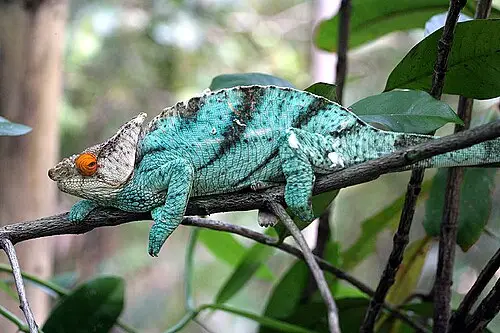
 📸 Photo
Photo: JialiangGao www.peace-on-earth.org · CC BY-SA 4.0 · Wikimedia Commons Source
Parson's Chameleon
Calumma parsonii (Parson's Chameleon · パーソンカメレオン)
💡 Everyday Comparisons for Size, Mass & Speed
- 💡 Its weight of 700 g is about the weight of three or four apples (Comparison).
- 💡 Large and expensive, it is sold in the pet trade for 1,500–3,000 dollars per animal, though no legally established captive-breeding program exists (ADW 'Economic Importance for Humans: Positive').
- 💡 Its average length of 60 cm is equal to two 30 cm rulers placed end to end (Comparison).
Reference standards: coach bus ~12 m, mid-size car ~4.9 m, compact car ~1 t, basketball hoop 3.05 m, credit card 8.56 cm.
Site-computed relative index from recorded values; not a formal scientific metric.
📖 1. Overview
Parson's Chameleon is the largest living species of chameleon, inhabiting humid forests of eastern Madagascar.
🦴 2. Anatomy & Morphology
Full-grown adults exceed 60 cm in total length, with an average snout-to-vent length of 20–30 cm and a weight of about 700 g. It is characterized by a prominent Pinocchio-like nasal protrusion, and males are brighter and more colorful.
🔍 3. Ecology & Behavior
It is an ambush hunter that eats leaves, insects, and occasionally small birds, catching mainly praying mantises, beetles, moths, and cockroaches. It anchors itself by wrapping its tail around branches, and its breeding season runs from May to October.
🇰🇷 4. Connection to Korea
No direct record connecting this species to Korea has been found.
📚 Sources & References
- • IUCN Red List NT (2011) — https://www.iucnredlist.org/species/172896/6937628
- • IUCN Red List category NT — latest assessment at iucnredlist.org
- • catalogueoflife.org — Q4TH
- • iucnredlist.org — 6937628
- • wikidata.org — Q664973
- • commons.wikimedia.org — File:Calumma Parsonii Ste Marie Madagascar.jpg
- • animaldiversity.org — Calumma parsonii
- • Silhouette: PhyloPic — author not recorded · CC0 1.0 (Related taxon silhouette — Brookesia brunoi)
Recorded dimensions are widely cited representative estimates from public literature and may vary by study or specimen.