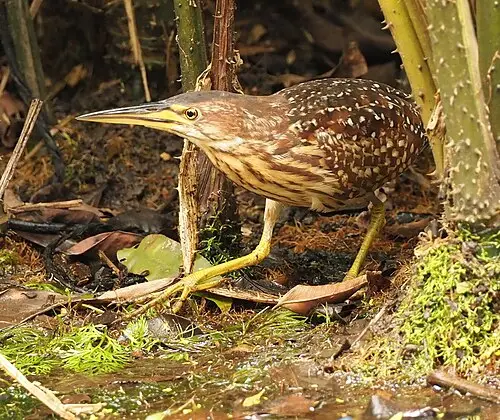
 📸 Photo
Photo: Rosario (argonauta) · CC BY 4.0 · Wikimedia Commons Source
Von Schrenck's Bittern
Botaurus eurhythmus (Von Schrenck's Bittern · サンカノゴイ属)
Not Evaluated (NE) on the IUCN Red List yet.
🇰🇷 Class II endangered wildlife (Korea)
💡 Everyday Comparisons for Size, Mass & Speed
- 💡 Its body length of about 36 cm is around 1.2 times the long side of an A4 sheet of paper (29.7 cm) (Comparison).
- 💡 The Heron Specialist Group notes that this bird also uses rice paddies as feeding grounds.
Reference standards: coach bus ~12 m, mid-size car ~4.9 m, compact car ~1 t, basketball hoop 3.05 m, credit card 8.56 cm.
📖 1. Overview
Von Schrenck's bittern is a small bittern that breeds in eastern Russia, Korea, eastern China, and northern Japan, and migrates south to the Philippines and Indonesia for winter. Heron Specialist Group materials use its former scientific name Ixobrychus eurhythmus.
🦴 2. Anatomy & Morphology
It is a small bittern with a body length of 33–36 cm.
🔍 3. Ecology & Behavior
It eats small fish, shrimp, isopods, dragonfly larvae, and mole crickets. From May to August (months 5–8), it builds a small cone-shaped nest of dry grass in waterside reeds or bushes within 1 m of the ground and usually lays 3–5 eggs.
🇰🇷 4. Connection to Korea
In Korea, it is a Class II endangered wildlife (Korea) species. The Heron Specialist Group includes Korea in its breeding range.
📚 Sources & References
- • 멸종위기 야생생물 Ⅱ급 — 국가생물종목록(국립생물자원관) ktsn 120000001525 — https://species.nibr.go.kr/home/mainHome.do?cont_link=009&subMenu=009002&contCd=009002&ktsn=120000001525
- • IUCN Red List: not evaluated (NE) — cross-checked with the Wikidata conservation-status entry
- • Korean protection status: Class II endangered wildlife (Korea)
- • doi.org — avilist.v2026
- • 국가생물종목록(국립생물자원관) ktsn 120000001525 — https://species.nibr.go.kr/home/mainHome.do?cont_link=009&subMenu=009002&contCd=009002&ktsn=120000001525
- • wikidata.org — Q739050
- • heronconservation.org — schrencks-bittern
- • Silhouette: PhyloPic — Matej Frantisek Calfa · CC BY 4.0 (Related taxon silhouette — Egretta garzetta)
Recorded dimensions are widely cited representative estimates from public literature and may vary by study or specimen.