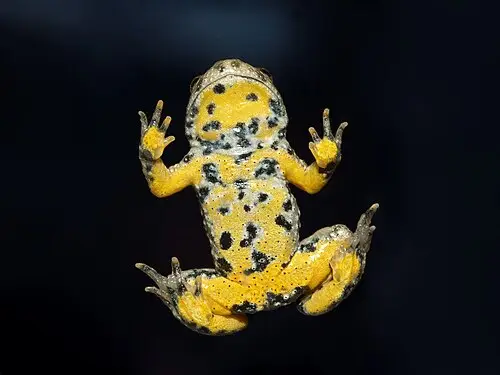
 📸 Photo
Photo: Waugsberg · CC BY-SA 3.0 · Wikimedia Commons Source
Yellow-bellied Toad
Bombina variegata (Yellow-bellied Toad · キバラスズガエル)
💡 Everyday Comparisons for Size, Mass & Speed
- 💡 A maximum length of about 5 cm is almost equal to two Korean 500-won coins (26.5 mm diameter) placed side by side (53 mm) (Comparison).
- 💡 Today it is found in puddles at gravel and clay pits, construction sites, and waste disposal sites, whereas in the past it was also common around farmsteads and wheel-rut puddles (Swiss KARCH).
Reference standards: coach bus ~12 m, mid-size car ~4.9 m, compact car ~1 t, basketball hoop 3.05 m, credit card 8.56 cm.
📖 1. Overview
The Yellow-bellied Toad (Bombina variegata) is a small European frog that originally inhabited river floodplains, but as those disappeared it now lives in human-made temporary pools such as quarries. In Switzerland it is listed as Vulnerable (VU).
🦴 2. Anatomy & Morphology
Measuring just under 5 cm in body length, it has an oval body covered with many warty tubercles. Its muddy-brown back blends into the surroundings, while its yellow-and-black or bluish patterned belly varies by individual for identification; breeding males develop black nuptial pads on their forearms and thumbs.
🔍 3. Ecology & Behavior
Most active at night, it feeds on small live animals found on land, while toxic skin secretions protect it from bacteria and predators. The breeding season runs from late April to early August (peaking in May–June), when eggs are attached to vegetation in sunny, warm, shallow pools.
🇰🇷 4. Connection to Korea
No direct record connecting this species to Korea has been found.
📚 Sources & References
- • IUCN Red List LC (2024) — https://www.iucnredlist.org/species/77970289/228179967
- • IUCN Red List category LC — latest assessment at iucnredlist.org
- • catalogueoflife.org — 5WNNK
- • iucnredlist.org — 228179967
- • wikidata.org — Q606431
- • commons.wikimedia.org — File:Bombina variegata 32.jpg
- • karch.ch — gelbbauchunke.html
- • bok.or.kr — contents.do
- • Silhouette: PhyloPic — Luca Leicht · CC BY 4.0
Recorded dimensions are widely cited representative estimates from public literature and may vary by study or specimen.