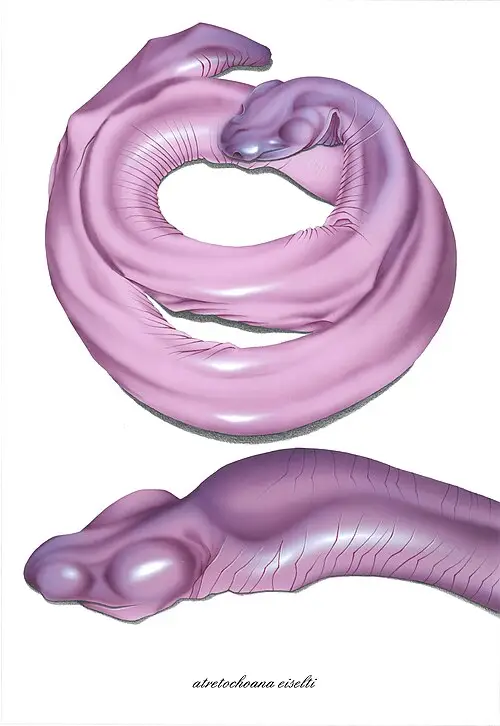
 📸 Photo
Photo: Tobias von Anhalt · CC BY-SA 3.0 · Wikimedia Commons Source
Eiselt's Caecilian
Atretochoana eiselti (Eiselt's Caecilian · Eiselt's Caecilian)
💡 Everyday Comparisons for Size, Mass & Speed
- 💡 A total length of 738 mm is about 74 cm, longer than a folded umbrella (about 60 cm) (Comparison).
- 💡 Compared with the next largest lungless salamander (up to 325 mm), this species is more than twice as long (Comparison).
Reference standards: coach bus ~12 m, mid-size car ~4.9 m, compact car ~1 t, basketball hoop 3.05 m, credit card 8.56 cm.
📖 1. Overview
Eiselt's Caecilian is a lungless caecilian and the largest known lungless tetrapod. Long known from only a single type specimen, it is listed as Least Concern (LC, assessed in 2023) on the IUCN Red List.
🦴 2. Anatomy & Morphology
Measuring 738 mm in total length, it completely lacks pulmonary arteries and veins, has sealed internal nostrils (choanae), and possesses a skull structure markedly different from other tetrapods. Its laterally compressed body and fin-like dorsal fold indicate an aquatic lifestyle.
🔍 3. Ecology & Behavior
A 1997 study interpreted its loss of lungs and reliance on cutaneous gas exchange as linked to life in cold, oxygen-rich, fast-flowing mountain streams, and suggested that its wider gape altered the size or type of prey it consumes. The next largest lungless salamander (Pseudoeurycea belli) reaches at most 325 mm, less than half the length of this species.
🇰🇷 4. Connection to Korea
No direct record connecting this species to Korea has been found.
📚 Sources & References
- • IUCN Red List LC (2023) — https://www.iucnredlist.org/species/59493/184643280
- • IUCN Red List category LC — latest assessment at iucnredlist.org
- • catalogueoflife.org — 67WDF
- • iucnredlist.org — 184643280
- • wikidata.org — Q1916885
- • commons.wikimedia.org — File:Atretochoana eiselti.jpg
- • bmnh.org — MW 97 BJLS.pdf
Recorded dimensions are widely cited representative estimates from public literature and may vary by study or specimen.