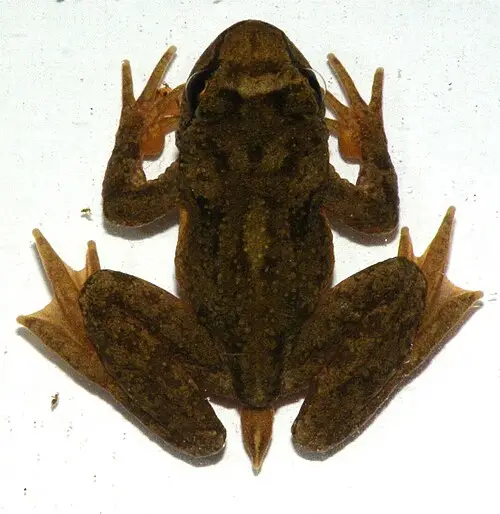
 📸 Photo
Photo: Mokele · CC BY-SA 3.0 · Wikimedia Commons Source
Coastal Tailed Frog
Ascaphus truei (Coastal Tailed Frog · Coastal Tailed Frog)
💡 Everyday Comparisons for Size, Mass & Speed
- 💡 A body length of 5.1 cm is similar to two Korean 500-won coins placed side by side (about 5.3 cm) (Comparison).
- 💡 Because it is highly sensitive to habitat changes, it can serve as an indicator species for assessing stream health (ADW, 'Economic Importance for Humans: Positive').
Reference standards: coach bus ~12 m, mid-size car ~4.9 m, compact car ~1 t, basketball hoop 3.05 m, credit card 8.56 cm.
📖 1. Overview
The Coastal Tailed Frog is a distinctive frog living in clear, cold mountain streams, where males mate using a tail-like copulatory organ. It is listed as Least Concern (LC, assessed in 2022) on the IUCN Red List.
🦴 2. Anatomy & Morphology
Body length ranges from 2.2 to 5.1 cm, with rough skin and coloration varying from brown to chocolate brown or olive green to match the streambed. Adapted to fast-flowing currents, its lungs are greatly reduced and appear to serve mainly for buoyancy control, while its hard, keratinized toe tips help it crawl among rocks on the stream bottom.
🔍 3. Ecology & Behavior
At night, it forages for insects, other arthropods, mollusks, and plankton, and breeds underwater in autumn from September to October. Because the tadpole stage is long, its streams must have permanent water flow; it does not hibernate in winter, though its activity decreases.
🇰🇷 4. Connection to Korea
No direct record connecting this species to Korea has been found.
📚 Sources & References
- • IUCN Red List LC (2022) — https://www.iucnredlist.org/species/54414/196332997
- • IUCN Red List category LC — latest assessment at iucnredlist.org
- • catalogueoflife.org — H5CV
- • iucnredlist.org — 196332997
- • wikidata.org — Q996518
- • commons.wikimedia.org — File:Ascaphus truei web.jpg
- • animaldiversity.org — Ascaphus truei
- • Silhouette: PhyloPic — Jose Carlos Arenas-Monroy · CC0 1.0
Recorded dimensions are widely cited representative estimates from public literature and may vary by study or specimen.