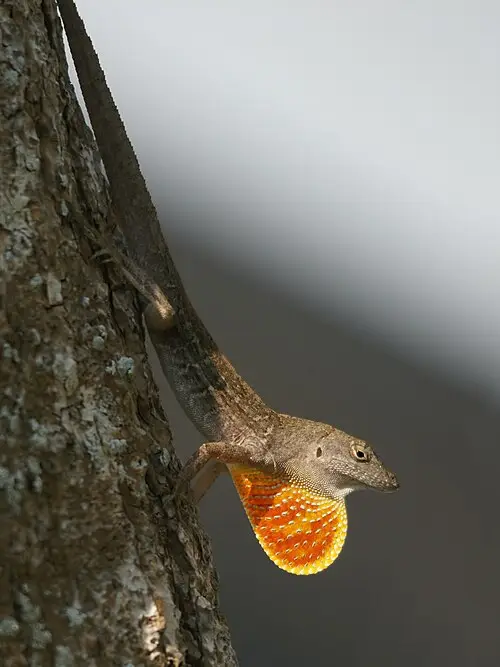
 📸 Photo
Photo: Hans Hillewaert · CC BY-SA 4.0 · Wikimedia Commons Source
Brown Anole
Anolis sagrei (Brown Anole · ブラウンアノール)
💡 Everyday Comparisons for Size, Mass & Speed
- 💡 It helps by eating pests such as cockroaches and spiders and is popular as a pet, though some people find its high numbers in cities a nuisance (ADW positive and negative impacts).
- 💡 An adult male's maximum weight of 8 g is similar to a Korean 500-won coin (about 7.7 g) (Comparison).
Reference standards: coach bus ~12 m, mid-size car ~4.9 m, compact car ~1 t, basketball hoop 3.05 m, credit card 8.56 cm.
Site-computed relative index from recorded values; not a formal scientific metric.
📖 1. Overview
The Brown Anole is a small lizard native to the Caribbean region, including Cuba, and has spread widely to become very common in cities as well.
🦴 2. Anatomy & Morphology
Males are larger than females and have a throat fan (dewlap) extended during threat displays or courtship. Full-grown males typically measure 54 mm in snout-to-vent length and weigh 6–8 g, while females measure about 43 mm and weigh 3–4 g.
🔍 3. Ecology & Behavior
It feeds mostly on arthropods such as spiders and beetles, along with earthworms, snails, and occasionally hatchling Green Anoles. It breeds from spring to late summer, with females laying 15–18 eggs in a season and young reaching adulthood after about 1 year.
🇰🇷 4. Connection to Korea
No direct record connecting this species to Korea has been found.
📚 Sources & References
- • IUCN Red List LC (2020) — https://www.iucnredlist.org/species/197443/2484119
- • IUCN Red List category LC — latest assessment at iucnredlist.org
- • catalogueoflife.org — 5V5QJ
- • iucnredlist.org — 2484119
- • wikidata.org — Q790586
- • commons.wikimedia.org — File:Anolis sagrei sagrei (displaying).jpg
- • animaldiversity.org — Norops sagrei
- • Silhouette: PhyloPic — Beth Reinke · CC0 1.0
Recorded dimensions are widely cited representative estimates from public literature and may vary by study or specimen.