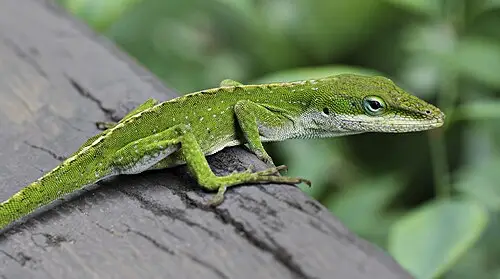
 📸 Photo
Photo: Paul Hirst ( Phirst ) · CC BY-SA 2.5 · Wikimedia Commons Source
Green Anole
Anolis carolinensis (Green Anole · グリーンアノール)
💡 Everyday Comparisons for Size, Mass & Speed
- 💡 In the United States it is commonly sold in pet stores, helps control pests by eating spiders, moths, and crickets, and is also used in behavior research (ADW 'Economic Importance for Humans: Positive').
- 💡 Its maximum weight of 6 g is slightly heavier than a Korean 100-won coin (about 5.4 g) (Comparison).
Reference standards: coach bus ~12 m, mid-size car ~4.9 m, compact car ~1 t, basketball hoop 3.05 m, credit card 8.56 cm.
Site-computed relative index from recorded values; not a formal scientific metric.
📖 1. Overview
The Green Anole is a small, mainly tree-dwelling lizard and one of the lizards most commonly seen in cities and suburbs.
🦴 2. Anatomy & Morphology
It weighs 2–6 g, and its tail makes up more than half of its total length. Its color ranges from brown to green and gray, produced by three overlapping layers of pigment cells.
🔍 3. Ecology & Behavior
It is an insectivore that eats almost anything smaller than its head, catching beetles, flies, and spiders, and captures more than 58% of its prey by sitting and waiting in ambush. It is active during the day, and its breeding season runs from April to August.
🇰🇷 4. Connection to Korea
No direct record connecting this species to Korea has been found.
📚 Sources & References
- • IUCN Red List LC (2020) — https://www.iucnredlist.org/species/64188/18972474
- • IUCN Red List category LC — latest assessment at iucnredlist.org
- • catalogueoflife.org — 675MJ
- • iucnredlist.org — 18972474
- • wikidata.org — Q930252
- • commons.wikimedia.org — File:Anole Lizard Hilo Hawaii edit.jpg
- • animaldiversity.org — Anolis carolinensis
- • Silhouette: PhyloPic — Andy Wilson · CC0 1.0
Recorded dimensions are widely cited representative estimates from public literature and may vary by study or specimen.