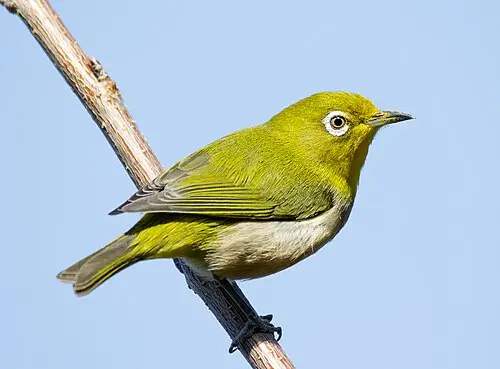
 📸 Photo
Photo: Laitche · CC BY-SA 4.0 · Wikimedia Commons Source
Warbling White-eye
Zosterops japonicus (Warbling White-eye · メジロ)
💡 Everyday Comparisons for Size, Mass & Speed
- 💡 Its body length of 12 cm is slightly shorter than a ballpoint pen (about 14 cm) (Comparison).
- 💡 It can be seen year-round in the evergreen broadleaf forests of the southern coast and Jeju Island (National List of Species of Korea).
Reference standards: coach bus ~12 m, mid-size car ~4.9 m, compact car ~1 t, basketball hoop 3.05 m, credit card 8.56 cm.
📖 1. Overview
The Warbling White-eye is a small bird with a white ring around each eye, and in Korea it is a year-round resident along the southern coast and on Jeju Island.
🦴 2. Anatomy & Morphology
Its upperparts are yellowish-green, its throat is yellow, its underparts are grayish-white, and its flanks are pale brown. Fine white feathers form a ring around the eye, and its blackish-brown bill is pointed and slightly curved downward.
🔍 3. Ecology & Behavior
It lives in evergreen broadleaf forests and builds a bowl-shaped nest on shrubs or climbing vines. Between April and July, it lays 3–5 white or pale blue eggs that both parents take turns incubating, feeding the chicks mainly insect larvae along with spiders, butterflies, and flies.
🇰🇷 4. Connection to Korea
According to the National List of Species of Korea, it is a resident bird inhabiting Jeju Island and the coastal and island regions of Gyeongsangnam-do and Jeollanam-do.
📚 Sources & References
- • IUCN Red List LC (2019) — https://www.iucnredlist.org/species/155158005/155636070
- • IUCN Red List category LC — latest assessment at iucnredlist.org
- • doi.org — avilist.v2026
- • iucnredlist.org — 155636070
- • 국가생물종목록(국립생물자원관) ktsn 120000072228 — https://species.nibr.go.kr/home/mainHome.do?cont_link=009&subMenu=009002&contCd=009002&ktsn=120000072228
- • wikidata.org — Q700028
- • commons.wikimedia.org — File:Japanese white-eye at Tennōji Park in Osaka, January 20
- • species.nibr.go.kr — mainHome.do
- • Silhouette: PhyloPic — Ferran Sayol · CC0 1.0 (Congeneric silhouette — Zosterops)
Recorded dimensions are widely cited representative estimates from public literature and may vary by study or specimen.