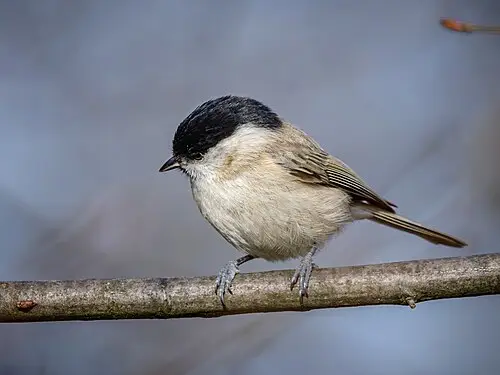
 📸 Photo
Photo: Stephan Sprinz · CC BY 4.0 · Wikimedia Commons Source
Marsh Tit
Poecile palustris (Marsh Tit · ハシブトガラ)
💡 Everyday Comparisons for Size, Mass & Speed
- 💡 Its weight of 10.7 g is about one and a half Korean 500-won coins (7.7 g) (Comparison).
- 💡 It also uses human-made artificial birdhouses as nests (National List of Species of Korea).
- 💡 In the United Kingdom, it is observed burying and hiding seeds taken from garden bird feeders in the ground (RSPB).
Reference standards: coach bus ~12 m, mid-size car ~4.9 m, compact car ~1 t, basketball hoop 3.05 m, credit card 8.56 cm.
Site-computed relative index from recorded values; not a formal scientific metric.
📖 1. Overview
The Marsh Tit is a small tit with a black crown and chin, and is a common resident bird seen across Korea.
🦴 2. Anatomy & Morphology
Its crown and chin are black, its upperparts are brownish pale gray without white wing bars, the area under the eyes and sides of the throat are white with a black bib, and the breast, flanks, and belly are grayish-white.
🔍 3. Ecology & Behavior
It builds a nest of grass and moss in tree hollows in the forest, holes excavated by woodpeckers, or artificial nest boxes, laying eggs in April–May. It eats insects and seeds, buries and caches seeds when food is plentiful, and forms flocks outside the breeding season.
🇰🇷 4. Connection to Korea
According to the National List of Species of Korea, it is a common resident bird seen nationwide in Korea.
📚 Sources & References
- • IUCN Red List LC (2025) — https://www.iucnredlist.org/species/22735995/154497836
- • IUCN Red List category LC — latest assessment at iucnredlist.org
- • doi.org — avilist.v2026
- • iucnredlist.org — 154497836
- • 국가생물종목록(국립생물자원관) ktsn 120000528889 — https://species.nibr.go.kr/home/mainHome.do?cont_link=009&subMenu=009002&contCd=009002&ktsn=120000528889
- • wikidata.org — Q207838
- • commons.wikimedia.org — File:Sumpfmeise im NSG Hirschacker und Dossenwald 2.jpg
- • species.nibr.go.kr — mainHome.do
- • bto.org — marsh-tit
- • rspb.org.uk — marsh-tit
- • Silhouette: PhyloPic — Andy Wilson · CC0 1.0 (Congeneric silhouette — Poecile carolinensis)
Recorded dimensions are widely cited representative estimates from public literature and may vary by study or specimen.