 📸 Photo
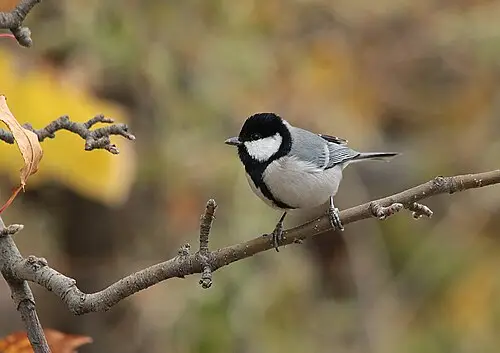
Photo: Imran Shah from Islamabad, Pakistan · CC BY-SA 2.0 · Wikimedia Commons Source
Cinereous Tit
Parus cinereus (Cinereous Tit · Cinereous Tit)
Not Evaluated (NE) on the IUCN Red List yet.
💡 Everyday Comparisons for Size, Mass & Speed
- 💡 It also breeds in artificial nest boxes put up by people (Encyclopedia of Korean Culture).
- 💡 Its body length of 14 cm is similar to five Korean 500-won coins (2.65 cm in diameter) lined up side by side (Comparison).
Reference standards: coach bus ~12 m, mid-size car ~4.9 m, compact car ~1 t, basketball hoop 3.05 m, credit card 8.56 cm.
📖 1. Overview
The Cinereous Tit is a small resident bird commonly seen across Korea, living everywhere from city parks to forests.
🦴 2. Anatomy & Morphology
Its head is black with a large white patch on the cheek, a black stripe runs from the throat down the middle of the belly, and a white wing bar is distinct.
🔍 3. Ecology & Behavior
It feeds mainly on insects and also eats tree seeds and grass seeds. From April to July, it lays 7–10 eggs in tree hollows, rock crevices, building gaps, or human-made nest boxes and incubates them for 12–13 days.
🇰🇷 4. Connection to Korea
It is a common resident bird widespread nationwide and the most common representative forest bird (the Encyclopedia of Korean Culture lists its scientific name as Parus major minor).
📚 Sources & References
- • IUCN Red List: not evaluated (NE) — cross-checked with the Wikidata conservation-status entry
- • doi.org — avilist.v2026
- • 국가생물종목록(국립생물자원관) ktsn 120000155331 — https://species.nibr.go.kr/home/mainHome.do?cont_link=009&subMenu=009002&contCd=009002&ktsn=120000155331
- • wikidata.org — Q973837
- • commons.wikimedia.org — File:Cinereous Tit (Parus cinereus) (15275201963).jpg
- • avifauna.hkbws.org.hk — 034800
- • encykorea.aks.ac.kr — E0020761
- • Silhouette: PhyloPic — Andy Wilson · CC0 1.0 (Congeneric silhouette — Parus atricapillus)
Recorded dimensions are widely cited representative estimates from public literature and may vary by study or specimen.