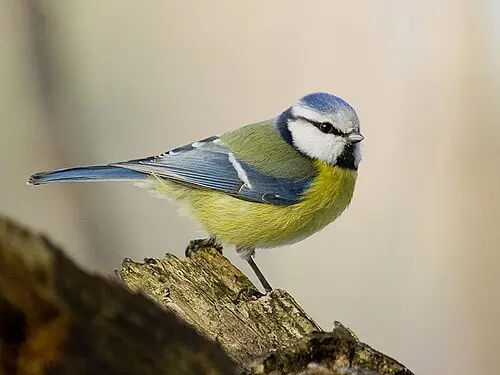
 📸 Photo
Photo: Sławek Staszczuk · CC BY-SA 3.0 · Wikimedia Commons Source
Eurasian Blue Tit
Cyanistes caeruleus (Eurasian Blue Tit · アオガラ)
💡 Everyday Comparisons for Size, Mass & Speed
- 💡 Its body length of 12 cm is slightly shorter than one ballpoint pen (about 14 cm) (Comparison).
- 💡 Its mass of 10.9 g is about one and a half Korean 500-won coins (7.7 g) (Comparison).
- 💡 One of the most easily recognized visitors to British gardens, it comes to bird feeders to peck at nuts (RSPB).
Reference standards: coach bus ~12 m, mid-size car ~4.9 m, compact car ~1 t, basketball hoop 3.05 m, credit card 8.56 cm.
Site-computed relative index from recorded values; not a formal scientific metric.
📖 1. Overview
The Eurasian blue tit is a small blue-and-yellow tit that frequently visits garden bird feeders in Europe and is common in woods and parks.
🦴 2. Anatomy & Morphology
Its plumage combines blue, yellow, white, and green, with a yellow breast, blue-green crown and wings, and a white face crossed by a black eye-stripe. Its black bill is very short and slender.
🔍 3. Ecology & Behavior
It eats insects, caterpillars, seeds, and nuts. In winter, family groups join other tits to roam in search of food, and when four or five birds are seen at a feeder, more than twenty may actually be visiting in turn.
🇰🇷 4. Connection to Korea
No direct record connecting this species to Korea has been found.
📚 Sources & References
- • IUCN Red List LC (2024) — https://www.iucnredlist.org/species/103761667/264532201
- • IUCN Red List category LC — latest assessment at iucnredlist.org
- • doi.org — avilist.v2026
- • iucnredlist.org — 264532201
- • wikidata.org — Q25404
- • commons.wikimedia.org — File:Parus caeruleus1.jpg
- • rspb.org.uk — blue-tit
- • bto.org — blue-tit
- • Silhouette: PhyloPic — Wouter Koch · CC0 1.0
Recorded dimensions are widely cited representative estimates from public literature and may vary by study or specimen.